

Cloud Workload Protection Best Practices
Sweet team
|
November 10, 2026
Cloud workloads change faster than any review cycle can keep up with. Cloud workload protection exists to close that gap: it establishes what a workload is supposed to do, observes what it actually does once it runs, and acts when the two stop matching. This guide covers how CWPP works, where it breaks, and the practices that make it durable. Capability names and coverage vary considerably between vendors and cloud providers, so the groupings below work better as an evaluation framework than as a feature checklist.
Key takeaways about cloud workload protection
- Cloud workload protection evaluates live workload behavior against intended activity, adding execution evidence to vulnerability, configuration, exposure, identity, and ownership data across cloud compute environments.
- CWPP security distinguishes theoretical findings from active risk by showing whether vulnerable components run, permissions are used, or suspicious processes and network connections occur in production.
- Effective protection must account for virtual machines, containers, serverless functions, and hybrid runtimes, where short-lived assets and varied telemetry can leave meaningful blind spots.
- Cloud workload protection best practices favor staged deployment: cover critical services, establish behavioral baselines and ownership, then introduce narrowly scoped enforcement for high-confidence malicious activity.
- Used alongside CSPM, CWPP connects configuration exposure with runtime behavior, helping teams rank remediation by reachability, execution evidence, identity blast radius, and data sensitivity.
Secure your cloud at runtime.
Continuously.
See Sweet prove where your cloud can be breached and stop it in real time, in a 30-minute walkthrough.
What is cloud workload protection (CWPP)?
A workload is any unit of compute that executes application code: a virtual machine, a container, a serverless function, a managed runtime. Cloud workload protection secures those units while they run. The platform category built around it is CWPP, short for cloud workload protection platform, a term Gartner introduced to describe workload-centric offerings that protect server workloads across physical, virtual, container, and serverless compute in hybrid and multi-cloud estates. Scanning and hardening happen before deployment. The decisive work happens after.
Consider a single example that will follow this article the whole way through: an internet-facing payments API. It runs an image containing a known vulnerable serialization library, it holds an IAM role with read access to storage buckets far beyond its job, and its security group permits broad egress. Three separate tools will report three separate findings, each accurate, none conclusive.
None of those findings establishes whether the vulnerable code path is loaded in memory, whether that over-permissioned role has ever been assumed, or whether the process just spawned a shell and opened an outbound connection. Protection begins where intent meets execution, and that is the question CWPP is built to answer continuously rather than quarterly.
Why is cloud workload protection important?
Teams that already run posture management, vulnerability scanning, and cloud-native logs reasonably ask what a separate workload capability adds. Those sources describe what could go wrong. They produce a list of conditions, commonly ranked by CVSS base scores, which by design exclude environmental factors such as whether the affected workload is reachable, running, or carrying sensitive data. Theoretical exposure is not the same as live risk.
The payments API makes the difference concrete. A critical CVE in a package that is never loaded is a backlog item. The same CVE in a process that is internet-reachable, holds credentials to production storage, and is actively serving traffic is an incident waiting for a trigger. Only observed execution separates the two, and base severity scores never will.
Protecting workloads across hybrid and multi-cloud environments
That execution evidence has to come from everywhere application code actually runs, which in most organizations is more than one provider and more than one compute model. Workload protection is defined by coverage breadth, because an attacker only needs the surface nobody instrumented.
- Virtual machines: Long-lived hosts where configuration drift, local accounts, and installed packages accumulate between rebuilds.
- Containers: Short-lived processes that may be replaced many times a day, often faster than a scan cycle completes.
- Serverless functions: Execution that exists only for the duration of an invocation, with identity and network behavior as the primary observable signals. Under the shared responsibility model, the provider secures the underlying runtime while the customer retains responsibility for function code, dependencies, and permissions.
- Managed and on-premises runtimes: Hybrid estates where the cloud control plane offers no view inside the workload at all.
Coverage tells you where to look. Timing determines whether looking helps.
Reducing risk throughout the workload lifecycle
Risk changes shape as a workload moves from build to deployment to production. Before deployment, the questions are about composition: what packages, what base image, what configuration. After deployment, the questions become behavioral: what processes started, what identities were assumed, what connections opened, what files changed.
Many programs invest heavily in the first set of questions and leave the second to log review. The result is an organization that can describe every workload it owns and still cannot say which one is being abused right now. Recognizing that gap is straightforward. Closing it requires a mechanism that connects configuration, identity, and execution into a single judgment.
How does a cloud workload protection platform work?
A cloud workload protection platform runs a continuous evidence loop rather than a scanning schedule. It establishes context about each workload, observes what that workload actually does, decides which observations are meaningful given the context, and applies enforcement proportionate to that decision. Remove any stage and the loop collapses back into a list of findings.
The loop has to run at the speed workloads change. A platform that refreshes its understanding once a day is describing an environment that may no longer exist, so both the context layer and the behavioral layer update continuously.
Continuous workload visibility and discovery
Context is the foundation, and it is more than an asset list. Useful cloud workload visibility records what a workload runs, what it is exposed to, what data it can reach, what identity it carries, and who owns it. For the payments API, that means knowing the service is internet-facing, that its role can read production storage, and that the platform team owns its deployment pipeline.
This context is what makes a later observation interpretable. An outbound connection from an internal batch job and the same connection from an internet-facing payment service are different events, even though the raw telemetry looks identical.
Runtime monitoring, detection, and response
With context established, the platform observes execution (process launches, file writes, network connections, identity use, and system calls) and compares that behavior against a baseline of what the workload normally does. Collection methods differ in depth and operational cost: eBPF-based and kernel-level sensors see process and syscall activity directly, while agentless snapshot scanning sees disk state without live execution. The tradeoff between visibility and deployment overhead is a real evaluation criterion and remains unsettled.
MITRE ATT&CK provides useful grounding for what those signals should surface. Credential theft through the cloud instance metadata service (T1552.005), command and control over application-layer protocols (T1071), and unexpected interpreter execution (T1059) all appear as behavioral deviations before they appear as outcomes.
The runtime decision loop
- Workload context: Attach exposure, identity, data access, and ownership to every running workload.
- Behavioral baseline: Learn the processes, files, and destinations that constitute normal operation for that specific workload.
- Deviation assessment: Evaluate new behavior against both the baseline and the context that determines its consequence.
- Proportionate enforcement: Act in proportion to confidence, from enriched evidence, to session termination, to blocking a specific behavior outright.
Each stage depends on capabilities that have to exist in the platform itself, which is where feature discussions belong, grouped by the decision they enable.
Key features and benefits of CWPP security
Feature lists are a weak basis for evaluating CWPP security, because the same capability name can describe very different levels of evidence. The sharper question is what each capability contributes to the loop: does it improve what the platform knows, or what the platform can do about it?
Vulnerability and configuration management
Vulnerability and configuration data enter the loop as context rather than as verdicts. The value of a software bill of materials or package inventory is that it can be intersected with execution: this library is present, this library is loaded, this process is reachable from the internet. That intersection narrows a large backlog to the subset of issues that are genuinely live, which is the premise behind runtime-informed vulnerability management.
Configuration state works the same way. A permissive egress rule is a finding on its own and evidence when paired with an observed connection to an unfamiliar destination. The second combination is the one that deserves an analyst's time.
Identity, access, and least-privilege controls
Workload identity is among the most consequential forms of context, because in cloud environments the role attached to a workload often determines blast radius more than the vulnerability inside it. The payments API matters because of what its credentials can reach, not its CVE count.
- Entitlement mapping: What the workload's role is permitted to do across accounts and services.
- Observed usage: Which of those permissions have actually been exercised, and by which process.
- Credential behavior: Whether tokens are being requested from unexpected processes or used from unexpected locations.
Comparing granted permissions against real usage turns least privilege into a measurable gap, and workload identity context is what connects a suspicious process to the access it could abuse.
Compliance reporting and security automation
Governance frameworks reinforce the same breadth. The Cloud Security Alliance's Cloud Controls Matrix spreads workload-relevant requirements across several domains, among them threat and vulnerability management, logging and monitoring, identity and access management, infrastructure and virtualization security, and incident response. No single control satisfies workload protection.
Automation matters because the evidence loop produces decisions faster than humans can transcribe them into tickets, isolation actions, and audit records. These capabilities describe how the loop is supposed to work. Production environments routinely break it.
Common cloud workload security challenges
The failures that undermine workload protection are usually operational rather than technical gaps in the platform: assets nobody can attribute, telemetry nobody has tuned, identities fragmented across accounts, and enforcement that teams are reluctant to turn on because the consequences of a false positive land on a revenue-generating service.
Ephemeral assets and incomplete asset inventories
A container that lives for seconds or minutes may never appear in a nightly inventory, and a serverless function can execute many thousands of times between two scan cycles. Any inventory built on periodic collection will be structurally incomplete, and the workloads it misses tend to be the short-lived ones that offer attackers the least observable footprint.
Ownership compounds the problem. When an anomaly surfaces on a workload with no recorded owner, the investigation stalls on a basic question: who can confirm whether this behavior is expected? Changing workloads require operational discipline — attribution, tagging, and lifecycle tracking — more than they require additional raw telemetry.
Securing containers, Kubernetes, and serverless workloads
Each compute model constrains what can be observed. On a VM, process and file activity are rich and continuous. In a container, the same signals exist but the subject disappears quickly, so evidence must be captured and attributed at the moment it occurs. In serverless, the observable surface narrows to invocation patterns, identity use, and network behavior, since the execution environment itself is managed by the provider.
Deeper container and Kubernetes implementation detail (admission control, pod security standards, service mesh policy) is beyond the scope of this guide. What matters here is that a workload protection program has to normalize these differences into one behavioral judgment instead of running three disconnected programs that never compare notes.
CWPP vs. CSPM: what's the difference?
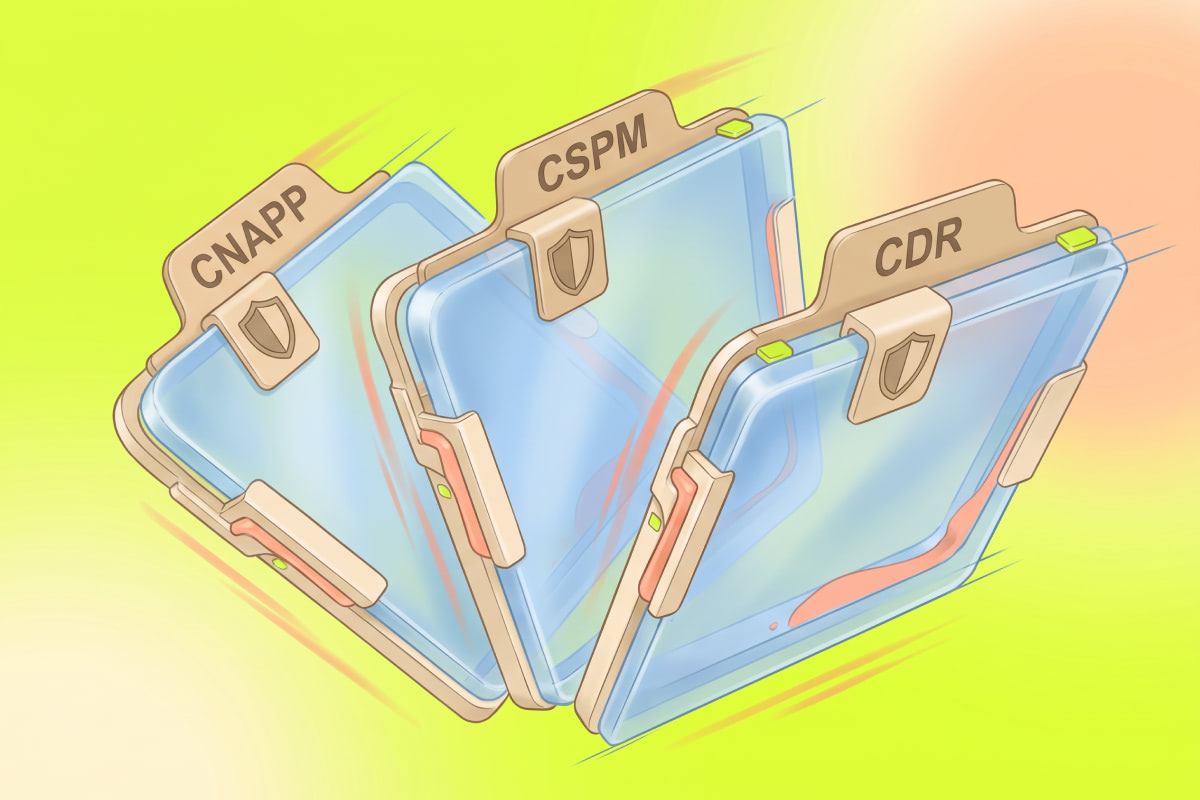
Those coverage differences often get confused with a category question, because posture management also claims to secure cloud workloads. The distinction is cleaner than most comparisons suggest. CSPM assesses cloud configuration and exposure: what should be true about an environment. CWPP protects execution: whether a workload's live behavior stays within that intent. Both capabilities are increasingly consolidated under the broader CNAPP category.
How CWPP and CSPM work together
The two are halves of one picture, which is why a runtime CSPM approach treats configuration state as input to behavioral judgment instead of as a separate report. Posture establishes that the payments API is internet-facing and over-permissioned. Runtime evidence establishes that the service just executed a shell and reached out to an unrecognized host.
Either fact alone produces a queue item. Together they produce a decision. Making that combination routine is what the remaining implementation work is for.
Cloud workload protection best practices
Because the loop fails operationally more often than technically, implementation has to be staged rather than switched on. The cloud workload protection best practices below are the payoff of everything above: each one exists to keep context, behavior, prioritization, and enforcement working together as workloads change.
Apply security controls from development through runtime
Controls applied in the pipeline are necessary and insufficient. They constrain what a workload starts as, not what it becomes. The sequence that holds in production starts with observation and ends with narrow, confident enforcement.
Phased rollout sequence
- Establish coverage: Deploy to critical workloads first: internet-facing services, those holding production data access, and those with broad identity privileges.
- Build baselines: Let the platform learn normal process, file, network, and identity behavior per workload before any action is configured.
- Validate ownership: Confirm every protected workload has an owner who can approve exceptions and confirm expected behavior.
- Enforce narrowly: Begin with high-confidence behaviors such as reverse shells or credential access from unexpected processes, then widen deliberately.
Broad blocking without baselines, ownership, and staged expansion risks disrupting production, and a single bad enforcement decision on a revenue path can cost a security program the organizational trust it depends on.
Prioritize remediation based on workload risk
Once behavior is observable, prioritization should stop being driven by severity scores alone. The useful ranking signals are the ones that establish whether an issue is live.
- Reachability: Whether the affected workload is exposed to untrusted networks or internal traffic only.
- Execution evidence: Whether the vulnerable component is loaded and running, not merely installed.
- Identity blast radius: What the workload's credentials can reach if the process is compromised.
- Data sensitivity: What the workload reads or writes during normal operation.
Applied to the payments API, those four signals move one CVE to the top of the list and push many others into a scheduled patch cycle.
Integrate CWPP with DevSecOps and incident response workflows
Prioritization only matters if the output lands where work happens. Behavioral findings should route to the owning team with the workload context already attached, and confirmed malicious behavior should trigger response workflows that isolate the workload, revoke its credentials, and preserve evidence before the container disappears. Sweet Security is one example of a platform built around this loop, connecting workload context to observed execution and behavioral enforcement in production; other vendors in the CNAPP market approach the same problem with different collection and enforcement models.
Every practice here returns to the question the introduction raised: does this workload's live behavior still match its intended role? Context, observed behavior, prioritization, and enforcement are four stages of one decision that has to be made continuously, because cloud workloads never stop changing. For a deeper look at how that decision operates across identities, APIs, and AI systems as well as workloads, read the complete runtime security guide.

Cloud workload protection FAQs
How does cloud workload protection secure my data?
Cloud workload protection secures data by monitoring the workloads that access it for abnormal processes, identity use, file activity, and network connections. It adds runtime context to detect and contain behavior that could expose sensitive data or abuse workload credentials.
How do I assess cloud workload protection tools?
Assess cloud workload protection tools by their coverage across virtual machines, containers, serverless functions, and hybrid runtimes, plus the quality of their runtime evidence. Evaluate whether they connect behavior to exposure, identity permissions, data access, ownership, and proportionate response actions.
What provides cloud workload protection?
A cloud workload protection platform (CWPP) provides cloud workload protection by continuously discovering workloads, monitoring runtime activity, and detecting or responding to suspicious behavior. It combines execution evidence with vulnerability, configuration, identity, and exposure context.
How to choose a cloud workload protection solution?
Choose a cloud workload protection solution that covers your compute models and provides timely visibility into process, file, network, and identity activity. It should support staged deployment, workload ownership, risk-based prioritization, and narrowly scoped enforcement to limit production disruption.
Which cloud workloads should be covered by CWPP, including virtual machines, containers, and serverless functions?
CWPP should cover every workload that executes application code, including virtual machines, containers, serverless functions, managed runtimes, and relevant on-premises systems. Prioritize internet-facing services, workloads with sensitive data access, and workloads with broad identity permissions.
What runtime signals can CWPP use to identify suspicious workload behavior?
CWPP can use process launches, system calls, file writes, outbound network connections, token requests, and identity use to identify deviations from normal behavior. Examples include unexpected shell or interpreter execution, metadata credential access, and connections to unfamiliar destinations.
How can teams prioritize cloud workload vulnerabilities based on active risk?
Teams can prioritize vulnerabilities using reachability, evidence that a component is loaded or running, the blast radius of workload credentials, and the sensitivity of accessible data. This focuses remediation on issues with credible production impact rather than severity scores alone.