Comparing 5 Top CWPP Vendors of 2026
Sweet team
|
November 9, 2026
Cloud workload protection platform (CWPP) is a category Gartner defined to describe workload-centric security controls that follow compute wherever it runs: physical servers, VMs, containers, Kubernetes nodes, and serverless functions, rather than attaching to a network perimeter. In practice, that means observing live workload behavior and enforcing policy against it. Most shortlists of top CWPP vendors 2026 look identical on paper, with broad workload coverage, behavioral analytics, and prevention on every datasheet. The differences surface when a live workload does something it has never done before. This comparison evaluates platforms on the evidence they can produce and the enforcement they can safely perform.
Key takeaways about top CWPP vendors 2026
- The top CWPP vendors 2026 differ less in stated coverage than in their ability to explain unfamiliar workload behavior with process, identity, network, and exposure context.
- The best cloud workload protection platform should be validated using a consistent proof-of-value scenario that tests detection, evidence quality, audit-mode policies, blocking, and post-event accountability.
- Features of CWPP vary by compute type: confirm whether containers, managed Kubernetes, legacy VMs, serverless functions, and AI workloads receive enforcement, observation-only coverage, or no support.
- Best runtime security for cloud workloads combines live behavioral evidence with safe, staged enforcement; agentless inventory and posture data cannot independently prove what occurred inside an active workload.
- Total value depends on deployment constraints, integrations, tuning requirements, response ownership, and operational costs—not license price or a broad capability matrix alone.
Disclosure: this comparison is published by Sweet Security, which appears among the vendors reviewed. Treat the criteria as a framework to test independently rather than as a neutral ranking.
Secure your cloud at runtime.
Continuously.
See Sweet prove where your cloud can be breached and stop it in real time, in a 30-minute walkthrough.
5 top CWPP vendors compared: side-by-side
Criteria only become useful when they are applied to every vendor the same way. The five platforms below are compared on four dimensions a buyer can test directly: what the platform observes at runtime, how it enforces, how it deploys, and what must be confirmed in a proof of value.
Methodology and scope: capabilities were drawn from current first-party vendor documentation at the time of writing, with no numeric scores and no inferred support. This is a focused sample, not a market survey. Several established CWPP and CNAPP vendors are not represented, and three of the five listed here are AI-workload specialists rather than general compute protection platforms. Vendor packaging changes frequently, so date-check every claim and treat any unconfirmed capability as "verify in POC."
Why CWPP tools matter in 2026
Cloud workloads change faster than static controls can describe them. Autoscaling groups replace instances on short cycles, managed services absorb infrastructure that no agent ever touches, and AI services run in production with permissions granted for a prototype. A configuration snapshot describes intent. Runtime evidence describes what a workload actually did.
This is why the best cloud workload protection platform is rarely the one with the longest capability matrix. It is the one that can establish what normal looks like for a specific workload and recognize the moment that behavior stops being normal.
Cloud workload risks CWPP helps address
The risks worth evaluating a vendor against are behavioral. Each maps to techniques catalogued in the MITRE ATT&CK Cloud and Containers matrices, and each produces observable runtime signals that a platform either captures with context or misses entirely.
- Unexpected process execution: A web service spawns a shell or an interpreter it has never executed in production.
- Credential access: A workload reads token, key, or instance-metadata paths outside its established pattern.
- Anomalous egress: A container opens outbound connections to destinations absent from its baseline.
- Runtime drift: Binaries, libraries, or configuration change inside a running workload after deployment.
- Identity misuse: A workload role is exercised from a process or session that never used it before.
A platform that sees these behaviors but cannot explain who initiated them and why they are unexpected produces findings, not decisions.
CWPP vs. CNAPP, CSPM, and cloud security posture tools
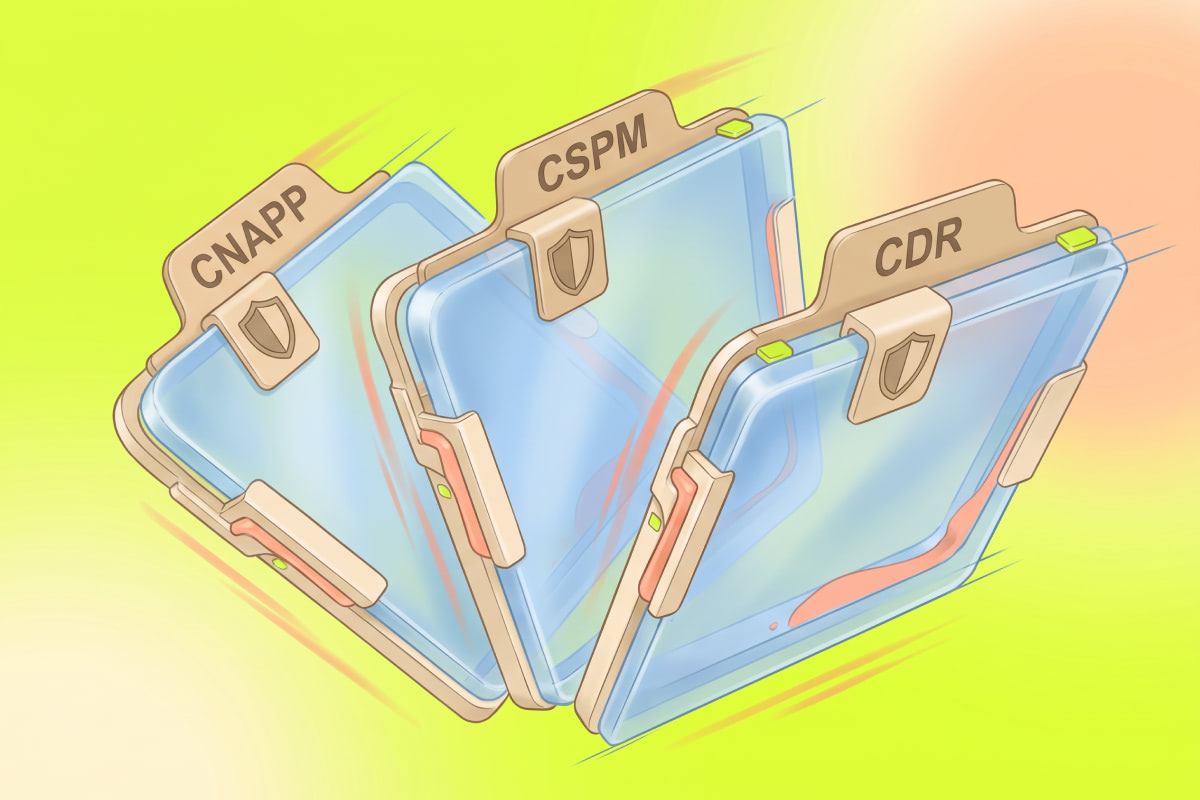
Posture tooling answers what could go wrong. Workload protection answers what is going wrong right now. CSPM evaluates configuration against policy and benchmarks, CNAPP suites bundle several categories under one contract, and runtime CSPM narrows posture findings using live context. None of them substitutes for the ability to observe a process tree inside a running workload.
The common buying mistake is comparing a posture product against a workload product using the same checklist. Keep the categories separate during evaluation, and translate each required capability into something you can verify.
Key features of CWPP you should look for
Features of CWPP are easy to claim and hard to disprove, so the list below is a set of verification questions rather than a capability catalog. For each one, the test is whether a vendor can demonstrate it against a workload in your environment.
Runtime threat detection and workload visibility
Ask what the platform collects, at what depth, and how long it retains it. Process lineage, file access, network connections, and the identity behind each action should resolve into one story rather than four separate feeds. Contextual cloud visibility matters here because the same shell execution is routine in a build runner and serious in an internet-facing service.
The question to put to every vendor: show me why this behavior was unexpected for this specific workload, and show me the evidence you used to decide.
Vulnerability management and risk prioritization
Every vendor scans. The differentiator is whether the platform can tell you which vulnerable package is actually loaded in a running process, reachable from an exposed path, and attached to a privileged identity. Prioritization that reorders a backlog using CVSS severity alone moves work around without reducing it.
Ask for a side-by-side count from your own environment: total findings versus findings confirmed as loaded and reachable at runtime. The gap between those two numbers is the value you are buying. Reachability analysis has limits. Dynamically loaded code, reflection, and infrequently exercised paths can all produce false negatives, so ask how the vendor handles those cases instead of assuming the filtered list is complete.
Container, Kubernetes, VM, and serverless protection
Coverage claims collapse under specifics. Confirm which compute types support full enforcement, which support observation only, and which fall outside scope entirely. For container implementation depth, read the dedicated container-security guidance rather than relying on a coverage row.
Compute boundaries to confirm in writing
- Self-managed nodes: Usually full sensor deployment and inline enforcement; confirm kernel version and distribution support.
- Managed Kubernetes data planes: Enforcement depth varies by provider and node type.
- Fargate-style tasks: Often sidecar-dependent; ask what is lost without node access.
- Serverless functions: Frequently observation-only or out of scope.
- Legacy VMs: Confirm agent support for older operating systems still running in production.
Best runtime security for cloud workloads: what sets leading vendors apart
Use one scenario across every vendor demo. An internet-facing workload spawns an unexpected shell, reads a credential path, and opens an outbound connection to an unfamiliar destination. The best runtime security for cloud workloads is the platform that handles all three moments well, not just the first.
Watch five things in sequence: whether the behavior is surfaced with context, whether the initiating identity and process tree are visible, whether a policy can be written against it, whether that policy can run in audit before it blocks, and whether the action is auditable afterward. Platforms that stop after step one add another queue to your week.
Agent-based and agentless runtime protection
Deployment model determines what evidence is even possible, so compare approaches instead of accepting a single label. eBPF-based sensors, now the common approach for Linux workloads, run instrumented programs in the kernel to observe syscalls without requiring a custom kernel module.
Most established vendors now offer hybrid deployments, which makes the real question narrower: when the shell spawns, which half of the architecture notices, and how quickly?
Detection accuracy, automated response, and investigation workflows
Accuracy, operationally, is measured by what a responder can do with a finding in the first few minutes. The timeline should open with the initiating identity, the parent process, the workload's normal pattern, and the deviation, not a severity label. Ask where detection and response ownership sits (vendor-managed, customer-run, or shared) and what the escalation path and response commitments look like outside business hours.
Then test enforcement safety. A platform should be able to run the same policy in audit mode long enough to show it would not have broken production before you let it block. A vendor that cannot demonstrate a staged rollout is asking you to accept that risk without evidence.
How to choose the right CWPP solution for your environment
Environment differences do not change the need for runtime proof. They change which proof matters and which deployment constraints are negotiable. A single-cloud team running mostly managed Kubernetes needs different evidence than a regulated enterprise with legacy VMs and several cloud accounts per business unit.
Build the proof of value around your constraints before vendors build it around their strengths.
Evaluate cloud coverage and deployment compatibility
Run the same five-stage sequence with every shortlisted vendor so the results are comparable.
- Estate scoping: List every compute type in production, including the ones nobody owns anymore.
- Enforcement mapping: Mark where each vendor can block, where it can only observe, and where it cannot deploy.
- Namespace deployment: Use a representative production workload, not a lab cluster built for the demo.
- Scenario execution: Run the shell, credential, and egress sequence, and capture what each platform produced.
- Audit-mode enforcement: Run two to four weeks and count what would have been blocked incorrectly.
Whatever survives that sequence is technically viable. Operational viability is a separate question. Workloads with monthly or quarterly batch patterns need longer baselines, since a short audit window will classify those jobs as anomalous.
Assess integrations, operational overhead, and total cost
Runtime evidence only helps if it reaches the systems your team already works in: ticketing, SIEM, identity providers, and CI/CD metadata. Review the vendor's integrations catalog against your actual stack rather than a generic list, and confirm which integrations are bidirectional.
Then price the work, not just the license: sensor rollout across node pools, baseline tuning, policy ownership, and data egress or retention charges. A platform with a lower per-workload price that consumes an engineer's week every month can easily be the more expensive option once staff time is counted.
Frequently asked questions about CWPP vendors
A few procurement questions tend to surface after the technical comparison is finished.
What is the best cloud workload protection platform?
There is no universal answer, and any vendor claiming one is offering a ranking rather than a fit assessment. The best platform for your environment is the one that produced usable runtime evidence for your own scenario and could enforce against it safely. Require a proof of value; a two-to-four-week test on a real workload is the evidence most likely to transfer to your estate.
Do organizations need CWPP if they already use CSPM?
In most cases, yes, because the two answer different questions. Posture tooling tells you a role is over-permissioned. Workload protection tells you that role was just used by a process that has never run before. If a CNAPP contract already includes a workload module, test that module against the same scenario before renewing. Overlapping licenses are common, and consolidation is only a win if the included component can actually enforce. Organizations whose production footprint is entirely managed PaaS or SaaS may get less from a workload agent and should weigh the coverage gap accordingly.
What should teams prioritize when comparing CWPP vendors?
Prioritize evidence quality and enforcement safety over feature breadth. Request raw telemetry access during the POC so you can validate findings independently, confirm data residency and retention terms in writing, and insist on an audit-mode period before any blocking policy goes live. Ask who owns response when a policy fires outside business hours; the answer changes the staffing cost of the platform.
Every criterion in this comparison reduces to one question: when a workload behaves in a way it never has before, can this platform prove what happened and act on it without breaking production? Feature matrices do not answer that. A scenario run against your own workloads does. As more of production becomes ephemeral, managed, and AI-driven, the gap between vendors that observe and vendors that can enforce on confirmed behavior gets harder to ignore.
FAQs On Comparing Top CWPP Vendors
How does CWPP establish a baseline for normal workload behavior?
CWPP establishes a baseline by observing a workload's usual processes, file access, network connections, identities, and execution patterns over time. It flags deviations, such as an unfamiliar shell or outbound destination, in the context of that specific workload's normal activity.
Can a CWPP block suspicious activity without disrupting production workloads?
Yes, but blocking policies should first run in audit mode to reveal what they would stop and identify false positives. Teams should validate policies over a representative period, including periodic workloads, before enabling enforcement.
What runtime evidence should a CWPP alert include for incident investigation?
A useful alert should include the initiating identity, parent and child process tree, affected workload, file or credential access, network activity, baseline deviation, and relevant exposure context. This evidence lets responders understand what happened and why the behavior was unexpected without pivoting among separate tools.
Which cloud workload types receive full CWPP enforcement versus observation-only coverage?
Self-managed nodes and many VMs commonly support sensor-based enforcement, while managed Kubernetes, Fargate-style tasks, and serverless functions may have reduced or observation-only coverage. Confirm enforcement depth for every production compute type, node configuration, and operating system in writing.
How long should a CWPP proof of value run before enabling blocking policies?
Run blocking policies in audit mode for two to four weeks on representative production workloads before enabling them. Extend the period for workloads with monthly, quarterly, or otherwise infrequent batch patterns so normal behavior is not treated as anomalous.
What are the limitations of agentless cloud workload protection?
Agentless protection can provide inventory, exposure context, and vulnerable-package data, but it cannot independently prove live process behavior, session activity, or syscall-level events inside an active workload. Its results also depend on snapshot frequency, creating potential staleness between scans.
How can runtime context improve vulnerability prioritization in cloud workloads?
Runtime context prioritizes vulnerabilities by showing whether a vulnerable package is loaded, reachable from an exposed path, and associated with a privileged identity. This helps teams focus on active risk rather than sorting every finding by severity score alone.