

Understanding & Comparing CWPP Alternative Frameworks
|
November 9, 2026
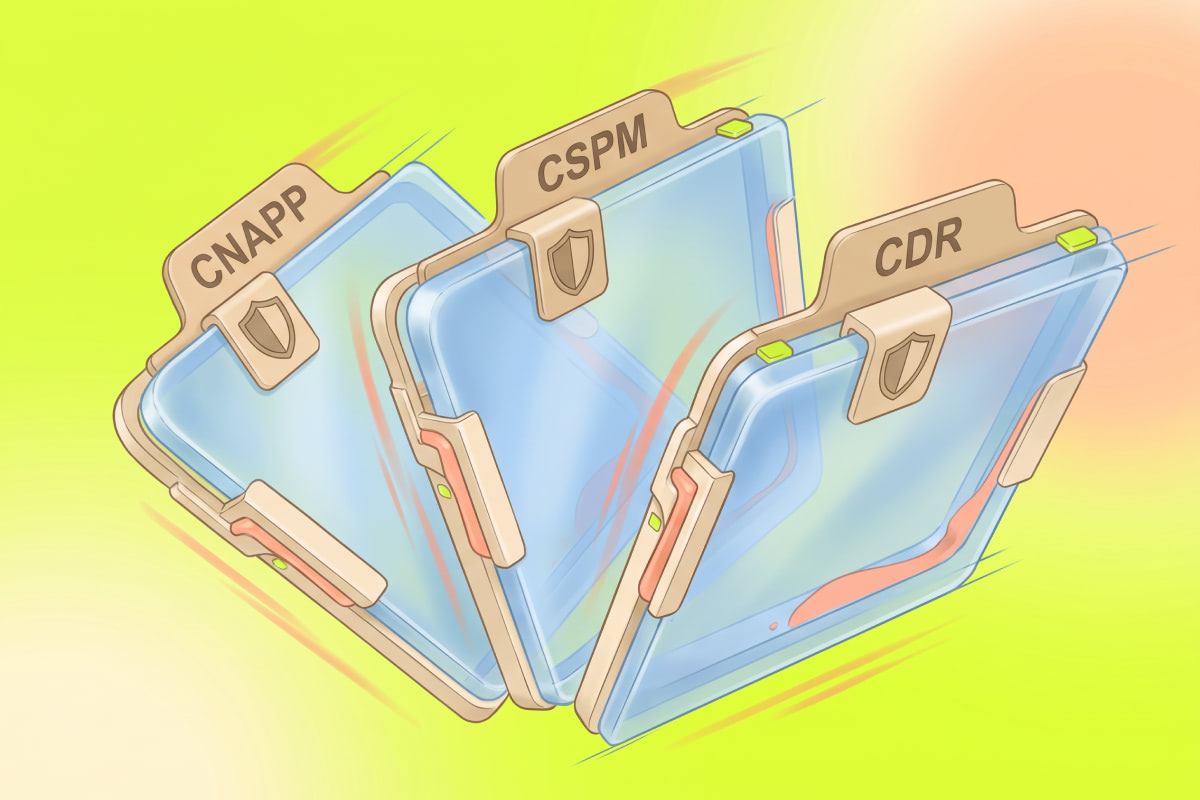
Configuration, entitlement, SaaS usage, and live workload behavior each produce different evidence, which is why so many CWPP alternative frameworks exist. This comparison maps CWPP against CNAPP, CSPM, CDR, CASB, and CIEM by the operational question each category can answer with confidence.
Key takeaways about CWPP alternative frameworks
- CWPP alternative frameworks address separate evidence sources: CWPP observes execution inside workloads, while other controls examine cloud configuration, permissions, SaaS activity, or broader cloud telemetry.
- In CWPP vs CNAPP, platform consolidation can correlate findings, but runtime depth still depends on direct insight and enforcement at the process, container, or function level.
- CWPP vs CSPM distinguishes observed exploitation from exposed conditions, while CWPP vs CDR pairs immediate workload context with account-level investigative sequences.
- CWPP vs CASB and CWPP vs CIEM cover SaaS data use and effective entitlements, helping teams address surfaces that runtime workload protection cannot see.
- Framework selection should prioritize the unanswered security question, then account for integration, accountable operational owners, and whether consolidation preserves the required depth of coverage.
One caveat applies throughout: these are category definitions, not product specifications. Individual vendors extend well past the boundaries described here, and the only reliable way to confirm coverage is to test a specific tool against your own architecture.
Secure your cloud at runtime.
Continuously.
See Sweet prove where your cloud can be breached and stop it in real time, in a 30-minute walkthrough.
What is CWPP, and why do alternative frameworks matter?
A cloud workload protection platform secures workloads while they run. The term was popularized by Gartner to describe workload-centric controls for hybrid and multi-cloud compute. A CWPP observes processes, file activity, memory, and network connections inside virtual machines, containers, and serverless functions, and it can block or isolate behavior that falls outside what a workload is supposed to do. Its evidence is execution, which is both its strength and the limit of what it can tell you.
Consider one composite environment: customer-facing Kubernetes services, cloud IAM roles binding those services to managed data stores, a sprawl of developer SaaS accounts, and managed cloud services configured through the control plane. A single bad day touches all four. The workload executes something unexpected, a role grants more than it should, a storage setting is open, and a SaaS account exfiltrates a file. Four risks, four evidence types, and no single category produces all of them. Each one is blind where another is native, which is the honest way to read the comparison below.
The most common objection to a table like this is that one row quietly absorbs the others. CNAPP is where that argument usually starts.
CWPP vs CNAPP: key differences and overlaps
The claim that CNAPP already contains CWPP is accurate as packaging and misleading as architecture. Bundling several controls under one platform changes who operates them and how findings are correlated. It does not change the fact that posture evidence, entitlement evidence, and execution evidence are gathered through different mechanisms and answer different questions.
Scope: workload protection vs platform-wide cloud security
CWPP has a narrow and deep scope: the workload itself, while it runs. CNAPP has a wide scope by design, spanning configuration, vulnerabilities, identities, data, and workload behavior across accounts and clouds. Depth and breadth are not substitutes for one another.
A cloud-native application protection platform is a platform umbrella rather than a direct replacement for every control underneath it. Two platforms carrying the same label can differ sharply in how much runtime visibility they provide; some instrument the workload directly, while others infer behavior from cloud provider logs. That is why the comparison that matters is capability-level, not acronym-level.
When CWPP is a component of a CNAPP strategy
CWPP belongs inside a CNAPP strategy when the platform treats workload behavior as first-class evidence rather than as another finding stream appended to posture results. The test is what the platform can tell you about a live process.
Tests for runtime depth inside a CNAPP
- Behavioral depth: Can the platform describe what a specific process, container, or function did, not just what it was built from?
- Enforcement point: Can it act on the workload itself, or only raise findings for someone else to action?
- Correlation direction: Does it use runtime evidence to prioritize posture and identity findings, or only the reverse?
Where the answers are weak, breadth is being mistaken for depth. That distinction becomes sharpest against the control that most CNAPP packages lead with: posture.
CWPP vs CSPM: comparing workload and posture management
Posture assessment is one of the oldest layers of cloud security, and in the CWPP vs CSPM comparison it is also the clearest boundary. CSPM reads the control plane and tells you what is misconfigured. It cannot tell you whether anything has acted on that misconfiguration.
Runtime threat detection vs configuration risk management
Return to the composite environment and narrow it to one exposure. A public Kubernetes service runs a container with an exploitable library, its service account is bound to an overprivileged role, and the storage bucket that role can reach allows broad access. CSPM surfaces the role and the bucket. Image scanning surfaces the library. All of it is potential.
CWPP answers the next question: is anything exploiting that path right now? Execution evidence is what converts a theoretical attack path into an observed one, and it is why runtime context for posture findings has become a practical way to prioritize a backlog that no team can fully remediate. Many CSPM implementations now include remediation workflows and attack-path analysis, but the category works from configuration state rather than process telemetry.
Using CWPP and CSPM together
Used together, the two controls resolve a single exposure in order rather than filling two independent queues.
Combined posture-and-runtime sequence
- Posture finding: CSPM identifies the overprivileged role and the permissive storage configuration as exploitable conditions.
- Runtime validation: CWPP establishes whether the workload holding that role is behaving as intended, or executing something outside its baseline.
- Prioritization: Confirmed execution against an exposed path moves ahead of findings that remain theoretical.
- Enforcement and fix: The workload behavior is contained while the configuration and entitlement are corrected permanently.
Step two assumes something worth examining more closely: that observed behavior is self-explanatory. Often it is not, which is the problem CDR was built around.
CWPP vs CDR: runtime protection approaches compared
Cloud detection and response widened the lens beyond the workload. CDR correlates control-plane logs, audit trails, and cloud service telemetry to identify an attack in progress across accounts and services, including techniques catalogued in the cloud matrices of MITRE ATT&CK. The CWPP vs CDR question is about where the evidence lives and where action is taken.
Preventive controls, detection, and incident response
A container spawning an unexpected shell is the canonical case. CWPP sees it at the source, including the process, its parent, and its network destination, and can terminate or isolate it immediately. CDR sees the surrounding sequence: the credential used, the API calls that followed, the resources touched in other accounts.
Each is incomplete alone. Cloud telemetry without workload context produces activity that is difficult to rank; workload evidence without the cloud sequence misses lateral movement. Effective detection and response workflows generally draw on both, which is why the detection-to-response boundary is where these categories most often merge in product terms.
Coverage across hosts, containers, and cloud services
Coverage differences follow from where each category collects its evidence, and implementations vary considerably across the three planes that make up cloud compute.
Evidence coverage by compute plane
- Hosts and VMs: CWPP is strongest here, with direct visibility into processes, files, and outbound connections.
- Containers and functions: CWPP covers short-lived workloads if its collection method survives their lifespan; CDR generally sees only what the cloud provider logs about them.
- Managed cloud services: CDR leads, because the control plane and service logs are typically the only evidence available for resources you cannot instrument.
Between them, those three planes cover compute. They say almost nothing about the two surfaces where cloud incidents often begin or spread: SaaS and identity.
CWPP vs CASB and CWPP vs CIEM: where each framework fits
CASB and CIEM are the clearest examples of adjacent categories that are frequently compared with CWPP and rarely substitute for it. They govern neighboring pathways into the same environment, using evidence that workload protection never sees.
CWPP vs CASB: protecting workloads and SaaS usage
The CWPP vs CASB comparison is a question of which asset you are defending. A cloud access security broker governs how people and applications use SaaS: which accounts are sanctioned, which data leaves them, which sessions look abnormal. Its evidence comes from SaaS APIs, proxied sessions, and user activity.
In the composite environment, that is the developer SaaS layer, including source repositories, ticketing, and file sharing, where sensitive data moves without a workload ever executing. CWPP has no visibility there, and CASB has none inside a running container. They overlap only when a workload calls a SaaS API, and even then they describe different halves of the transaction.
CWPP vs CIEM: managing workload identities and entitlements
Identity is the surface where the two categories genuinely interlock. Cloud infrastructure entitlement management inventories policies and calculates effective permissions, which is how teams apply least privilege to human and non-human identities. In the CWPP vs CIEM comparison, the dividing line is potential versus observed use.
Potential access versus observed access
- CIEM evidence: The role attached to a Kubernetes service account could reach every bucket in the account.
- CWPP evidence: The workload holding that role has only ever reached one bucket, on one schedule.
- Combined outcome: Entitlements can be scoped to actual behavior rather than estimated need, which is how workload identity security moves from a periodic review to a continuous one.
Six categories, six questions, and considerable overlap at the edges. The practical problem is deciding which of those boundaries your environment actually needs to cover.
How to choose the right cloud security framework for your environment
With the boundaries established, selection becomes a decision framework rather than a feature comparison. Buy for the question you currently cannot answer, not for the category with the longest capability list.
Assess your cloud architecture, assets, and threat model
Start by writing down which questions your existing controls already answer with evidence you would defend in an incident review.
Coverage questions to audit first
- Configuration state: Do you know what is misconfigured across every account, continuously rather than quarterly?
- Entitlement reality: Do you know the effective permissions of your non-human identities, and how many are unused?
- Live workload behavior: Can you describe what a specific production process did in the last hour?
- Cross-service sequence: Can you reconstruct an attacker's path across accounts and managed services?
- SaaS data flow: Do you know where regulated data sits in unsanctioned SaaS?
The weakest answer identifies the category to evaluate first. Everything else is sequencing.
Evaluate integration, operational ownership, and tool consolidation
The second objection to a layered approach is duplication, and it is a fair one. Two controls that produce the same finding without reconciling it create work rather than coverage. Consolidation is worth pursuing when it reduces the number of places a single risk has to be interpreted, not when it simply reduces the number of invoices. The trade-off runs the other way as well: a consolidated platform may be shallower in a specific domain than the point tool it replaces, so the comparison should be made capability by capability.
Ownership deserves equal weight. Posture findings usually belong to platform teams, entitlement reviews to identity owners, and runtime response to the security operations function. A framework that no team is accountable for will produce evidence nobody acts on, regardless of how complete the category coverage looks on paper.
Build a layered cloud security strategy
The right architecture depends less on headcount than on which question is most urgent. A small cloud-native team running a handful of Kubernetes services often has workable native posture coverage and no credible answer about live behavior; a focused runtime layer closes the largest gap first. A large multi-cloud organization with several overlapping point tools usually knows its exposures well and cannot correlate them; its work is rationalizing evidence into one operating model without losing depth at the workload.
For teams whose unresolved question is whether production behavior matches intent, Sweet Security is one example of a platform built around runtime evidence and behavioral enforcement rather than posture findings alone. It complements posture, identity, and SaaS controls rather than replacing them. Other vendors approach the same problem from the posture or detection side, and the right choice depends on which gap is widest in your environment.
Every comparison in this guide reduces to the same test: which question can this control answer with confidence, and which one is still unanswered in your environment? Workload execution, configuration state, cloud threat sequences, SaaS data use, and entitlement scope each produce evidence the others cannot, so the test is worth repeating as the architecture changes rather than only at procurement. For a deeper treatment of the runtime layer underneath this decision, read the complete runtime security guide.
CWPP alternative frameworks FAQs
How do CWPP alternative frameworks address cloud security gaps that workload protection cannot see?
CWPP alternative frameworks add evidence from configuration state, cloud activity, SaaS usage, and identity entitlements—areas that workload telemetry cannot directly observe. Together, they expose misconfigurations, excessive access, managed-service activity, and data movement outside running workloads.
When does a cloud security program need both runtime workload protection and broader cloud risk visibility?
A program needs both when it must distinguish exploitable conditions from active behavior and investigate activity beyond an individual workload. Runtime protection supplies process-level context, while broader visibility connects configuration, identities, accounts, and managed services.
How can teams use observed workload behavior to prioritize cloud misconfigurations?
Teams can elevate misconfigurations linked to workloads showing unexpected execution, suspicious connections, or access to exposed resources. This turns a theoretical attack path into an observed risk that should be contained and remediated first.
What cloud evidence is needed to investigate an attack that moves between workloads and managed services?
Investigations need workload process, file, and network evidence alongside cloud audit trails, control-plane logs, identity activity, API calls, and resource-access records. Combining these sources reconstructs both the initial execution and movement across cloud services.
Can runtime behavior help reduce excessive permissions for non-human cloud identities?
Yes, observed workload behavior can show which resources a non-human identity actually accesses and on what schedule. Teams can use that evidence with entitlement analysis to scope permissions closer to demonstrated need.
Which security controls help protect SaaS data and activity that do not run inside cloud workloads?
Controls that inspect SaaS APIs, user sessions, account activity, and data flows help govern SaaS data and usage. They cover sanctioned applications, abnormal sessions, and sensitive-data movement that workload protection cannot see.
What should teams test before consolidating cloud security controls into one operating model?
Teams should test whether consolidation preserves the required depth of runtime, posture, identity, SaaS, and cloud-activity coverage while correlating related findings. They should also verify enforcement points, integration quality, accountable owners, and whether a live incident can be investigated from the combined evidence.