

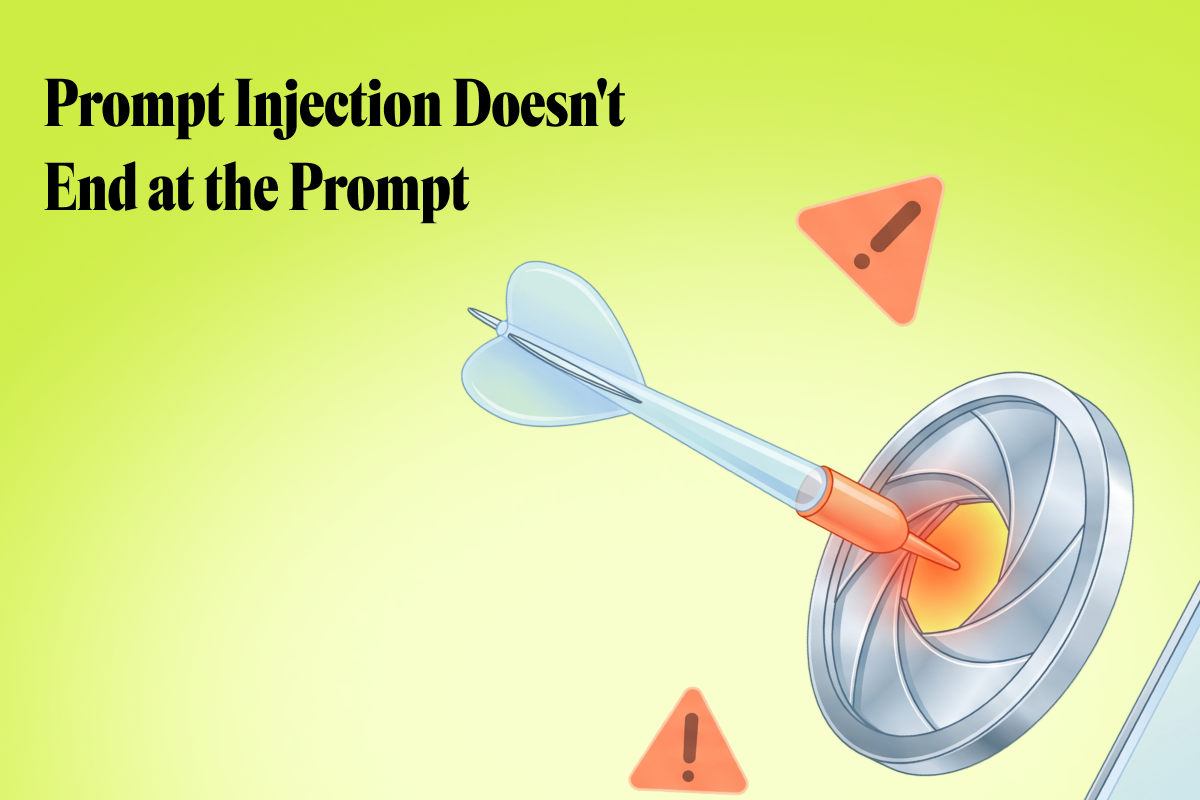
Prompt injection begins with an instruction, but the damage rarely ends there. Most defenses focus on preventing malicious instructions from reaching the model in the first place. Input filtering, hardened system prompts, and testing all matter because they reduce the likelihood that a model follows an instruction it should not, but they only address the beginning of the attack.
The larger security problem is what happens after a malicious instruction reaches an AI application. If that AI application can access data, call APIs, use credentials, or make changes to cloud infrastructure, the consequences extend beyond an incorrect or manipulated response. The access and permissions given to the AI application can turn that instruction into an action against a real system.
When AI Can Act, The Risk Changes
Consider an AI application that can read files, query databases, call APIs, or make changes to cloud infrastructure. Each of those capabilities requires some level of access, and that access determines how much damage a manipulated AI application can cause. It could expose sensitive data, misuse an API, modify a cloud resource, or send information somewhere it should never go.
The malicious instruction also does not have to come directly from the person using the AI application. An AI application asked to summarize a webpage could encounter instructions placed on that page specifically for the AI application reading it. The same technique can be used in a document, an email, an API response, or other data the AI application pulls into context during a task.
This creates a difficult problem for defenders because they do not control everything an AI application may interact with. Prompts can be inspected and content can be filtered, but no organization can guarantee that every application, API response, or external system an AI application encounters will be safe. As AI applications interact with more systems, the number of places a malicious instruction can originate grows with them.
Preventing those instructions from reaching or influencing the model remains important, but it cannot be the only line of defense. Security also has to account for what happens when one gets through: what the AI application can access, which permissions it can use, which systems it can communicate with, and what actions it is allowed to take. Those controls ultimately determine whether a successful prompt injection remains a model-level failure or becomes a security incident.
This also means AI applications cannot be secured in isolation from the cloud environments they operate in. An AI application ultimately acts through cloud identities, permissions, APIs, workloads, and data, and each of those provides context for determining whether an action is expected or introduces risk. Looking only at the AI layer leaves out the environment where those actions actually take place, while looking only at the cloud layer leaves out the AI context behind them.
Effective runtime security requires both. Defenders need to understand what the AI application is trying to do, the cloud resources and permissions involved, and whether the resulting behavior is appropriate for the task. Without that context, a critical part of the interaction remains invisible.
Stopping Prompt Injection at Runtime
This is where broader cloud runtime security becomes important. Sweet protects AI applications in the context of the environments they interact with, providing the context needed to understand what an AI application is actually doing rather than relying solely on whether the instruction that led to an action appeared malicious.
If an AI application attempts to access a resource it should not need, use permissions outside the scope of its task, or take an action that introduces risk, that behavior can be identified and stopped before it becomes an incident. This provides a second layer of defense for cases where a malicious instruction has already reached or influenced the model.
Prompt-level security and runtime security address different parts of the same problem. Filtering, hardened prompts, and testing reduce the likelihood that malicious instructions influence the model, while runtime security limits and mitigates what those instructions can accomplish if they do. Prompt injection may begin at the model, but its impact is determined by what the AI application can access and do across the cloud environment. Securing one without the other leaves a critical part of the attack path unprotected.
See It Live
Curious to learn more? Request a demo to watch Sweet enforce agent behavior in runtime, across both your agents and the cloud they run on.