


Runtime visibility gives security teams essential information: which workloads are running, how applications communicate, what identities they use, and where sensitive data moves. These capabilities are familiar to teams using runtime cloud security tools. The next challenge is turning that evidence into protection: proving what can be exploited, addressing the exposure, and responding to malicious behavior as it happens.
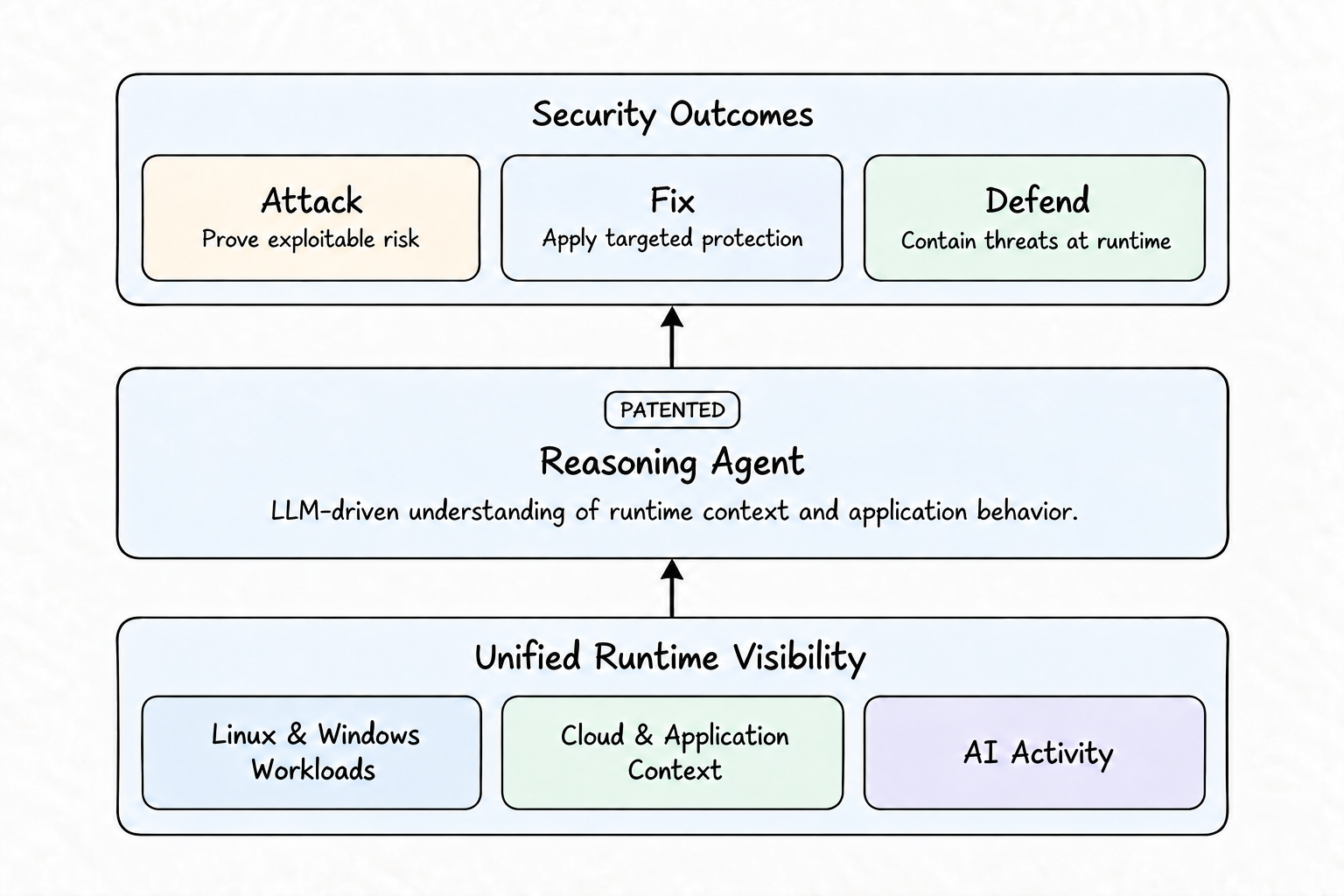
Sweet’s architecture connects those steps. A unified runtime foundation supplies the evidence, and patented, LLM-driven reasoning builds an understanding of each application. Attack, Fix, and Defend use that understanding to guide testing, protection, and response. Sensor-based tools connect those decisions to action in the running environment.
Runtime Visibility Across Linux and Windows Workloads
Sweet’s runtime foundation starts with observing applications in real time as they execute. On Linux, our eBPF sensors capture process execution and network activity through kernel hooks, while userspace instrumentation adds visibility into application behavior. Together, these runtime signals reveal how requests move through an application, which services they reach, and where sensitive data flows.
As workloads change, new connections form, or unexpected processes appear, that live evidence keeps Sweet’s application context grounded in what is happening in production. Attack uses it to guide testing, Fix uses it to inform targeted protection, and Defend uses it to detect and respond to malicious behavior at runtime. Our Windows sensor brings Windows workloads into the same foundation, connecting activity across both operating systems.
Integrated AI Visibility and Cloud Context
AI agents introduce runtime behavior that security teams need to understand in real time: the instructions an agent receives, the information it retrieves, and the tools it invokes. Sweet’s integrated AI Gateway brings visibility into prompts, responses, and tool interactions into the same runtime foundation, without a separate installation.
Sweet then connects those interactions to the agent’s workload, identity, and cloud access to establish what its behavior could mean for the business. If manipulated input redirects an agent toward sensitive data or an unauthorized tool, that context helps Sweet evaluate the potential impact and enforce boundaries while the application is running.
LLM-Driven Reasoning and Per-Application Behavioral Baselines
Runtime signals show what is happening in an application in real time. Understanding what that activity means requires context: a shell process launched by a build service may be routine, while the same activity originating from a customer-facing application could warrant further investigation. Sweet’s patented, LLM-driven reasoning agent combines those signals with key context to maintain a live model of each application. As the application operates and changes, that model establishes what normal behavior looks like and gives Attack, Fix, and Defend a shared understanding of the environment to evaluate risk and determine appropriate action.
Attack: Prove Exploitability Using Runtime Context
Sweet Attack uses live application context to discover vulnerabilities and test how they can be exploited. Understanding how services communicate and what resources they can access helps focus testing on viable paths through the environment. Attack then exercises those paths to prove how weaknesses can be chained together, giving teams evidence of what an attacker could reach and where to break the chain.
Proving a path to private infrastructure: In one customer environment, Sweet Attack uncovered an SSRF vulnerability in a public-facing application and demonstrated a path through an internal API and database to root-level access on a private EC2 instance in under four minutes. Runtime context connected the application to its internal dependencies, helping Attack investigate beyond the initial vulnerability and prove the full impact.
Fix: Apply Runtime Protection to Identified Vulnerabilities
Sweet Fix uses live application context to determine where protection is needed and how to apply it. Whether responding to a proven attack path or a newly disclosed threat, that understanding helps target the affected behavior and assess the impact on legitimate activity. Protection can be applied through the existing sensors, reducing exposure while security and engineering teams work on permanent remediation.
Stopping Shai-Hulud without stopping production: During the Shai-Hulud supply-chain attack, Sweet deployed a targeted sensor hotfix that terminated malicious processes while leaving surrounding workloads operational. Real-time visibility into process behavior and enforcement through those same sensors allowed Sweet to stop the malicious activity at its source while teams investigated and remediated the affected software.
Defend: Assess and Enforce Response Actions
Sweet Defend uses live application context to assess malicious or anomalous behavior as it occurs and determine how to contain it. Understanding the affected workload, identity, and application dependencies helps evaluate both the threat and the operational impact of intervening. Defend generates a response playbook and uses runtime enforcement to carry out selected actions in under 100 milliseconds.
Blocking unsafe AI-agent activity: When a prompt injection attempts to redirect an AI agent toward unauthorized tools or sensitive data, Sweet connects the interaction to the agent’s intended role, identity, and cloud access. That context helps determine when the agent is operating outside its boundaries and informs enforcement that blocks the out-of-scope interaction while allowing legitimate activity to continue.
Sweet Turns Runtime Understanding into Outcomes
Security teams are measured by the risk they reduce and the systems they protect. Runtime data matters because it enables those outcomes: understanding an exposure well enough to address it, stopping malicious activity before it spreads, and keeping legitimate applications running. Sweet’s architecture is built around that purpose, making runtime understanding the foundation for effective action across cloud and AI.
Book a customized demo with us to see how Sweet turns runtime signals into security outcomes.