

Runtime security depends on understanding what applications do while they run and being able to act when that behavior becomes malicious. Runtime telemetry provides the evidence: which processes execute, how services communicate, and which identities access resources. For organizations running Windows alongside Linux, Windows workloads need to contribute to that understanding.
At Sweet, this runtime intelligence feeds the Sweet Learning Loop. Attack, Fix, and Defend use shared application context to prove exploitable paths, apply protection, and contain active threats. Our Windows sensor brings Windows workload activity into that foundation, helping security teams connect what happens inside those workloads to the applications and cloud resources around them.
Our latest Windows sensor enhancements focus on reducing operational overhead while preserving that behavioral telemetry. This supports a practical requirement for runtime security: collecting the evidence needed to protect applications while respecting the production environments they run in.
Why Runtime Security Matters for Windows
Windows workloads remain foundational to the modern enterprise. Business-critical applications, .NET services, IIS servers, Windows containers, and internal services continue to power organizations across every industry. Protecting them requires understanding both their exposure and how they behave in production.
Attackers exploit running systems. They steal credentials, abuse identities, launch malicious processes, move laterally between workloads, and chain together weaknesses into successful attacks. A Windows application can be the entry point into an environment, a step along an attack path, or the system an attacker ultimately wants to reach. Investigating that activity requires seeing its connections to the rest of the environment.
Runtime intelligence provides that visibility through process execution, identity usage, application behavior, network activity, and workload interactions. It helps security teams answer questions such as:
- What processes are executing, and what launched them?
- Which identities are actively being used?
- What resources can the application reach?
- Are applications communicating with unexpected resources?
- Is this activity consistent with expected behavior?
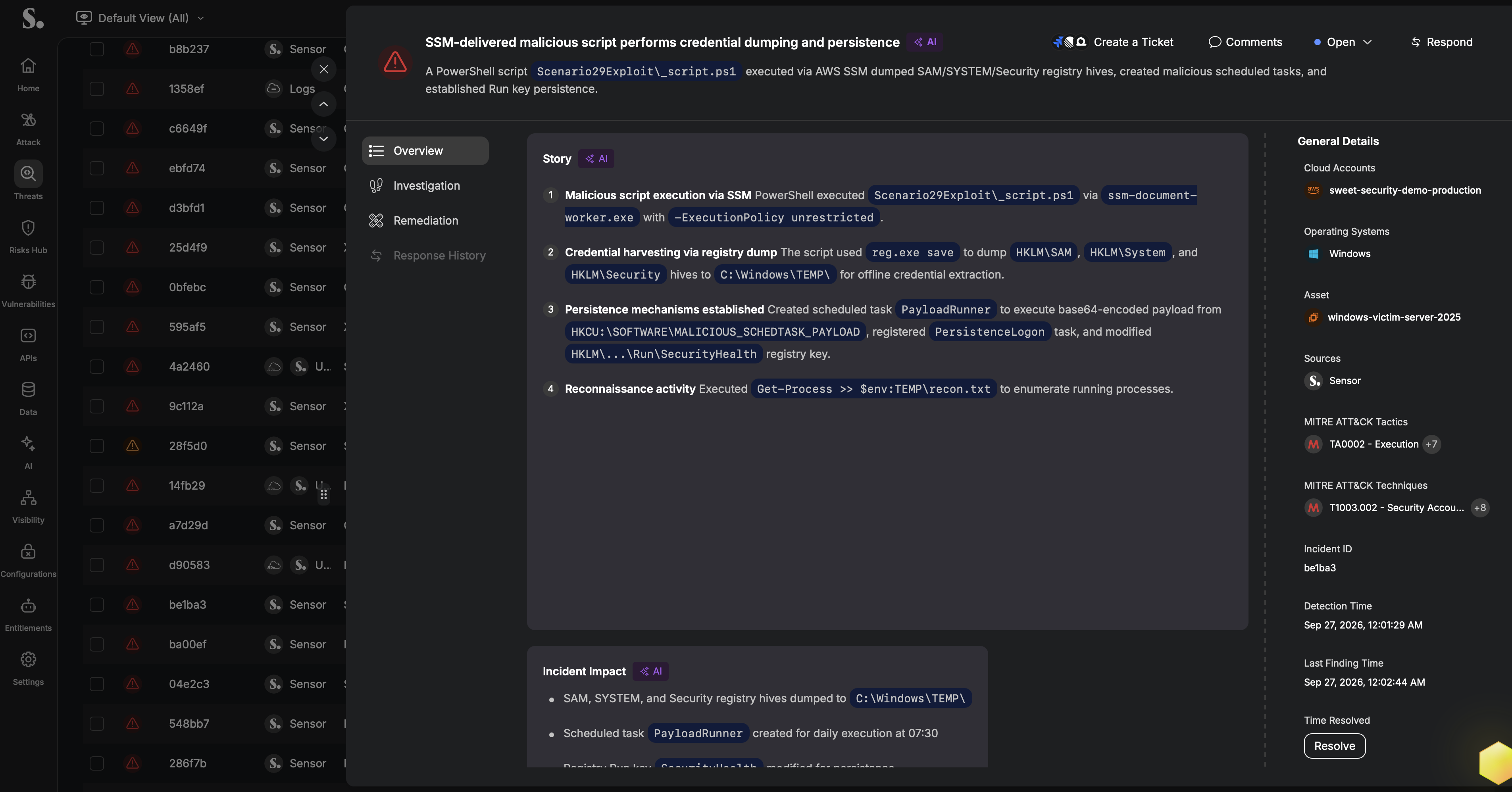
Consider a customer-facing application that unexpectedly launches a shell process. The process is a signal to investigate. Knowing what triggered it, which identity it uses, and where it communicates helps the team assess whether it is legitimate activity or part of an intrusion. Those relationships turn an isolated event into evidence that can guide a security decision.
Enhancing Runtime Intelligence Without Increasing Operational Overhead
Rich runtime visibility needs to be practical to deploy in production. Security teams need evidence from the workloads they protect, while application owners need those workloads to remain reliable. Lightweight sensors are a core competency at Sweet, reflected in our Linux sensors and our continued investment in Windows sensor efficiency.
With this latest release, we've enhanced our Windows runtime sensor to deliver the same behavioral telemetry with greater efficiency. The purpose is to reduce the operational burden of collecting runtime evidence.
Where lower overhead makes broader deployment practical, teams can bring more Windows workloads into their security coverage. That matters when an investigation crosses application or operating-system boundaries. If suspicious activity on one service leads to a Windows workload, visibility into that workload helps the team continue the investigation and understand the resources involved.
Attack, Fix, Defend. Powering the Sweet Learning Loop
The Sweet Learning Loop uses runtime evidence to build application understanding and connect it to action. Activity from Windows workloads contributes to that shared context, alongside signals from the wider environment. What Sweet learns about an application helps guide how it tests risk, applies protection, and responds to threats.
Attack: Sweet Attack uses runtime context to guide continuous AI red teaming and validate exploitable paths. Understanding service connections and resource access helps it test how weaknesses can combine and gives teams evidence of where to break an attack chain.
Fix: Sweet Fix uses application context to inform targeted runtime protection while teams pursue permanent remediation. During Shai-Hulud, Sweet deployed a sensor hotfix that terminated malicious processes while surrounding workloads remained operational. This platform example shows how runtime evidence and sensor enforcement can work together.
Defend: Sweet assesses suspicious behavior in its application context and supports containment through response actions and reusable playbooks. Analysts can move from investigation to action within the platform, with response history recording what was executed.
Together, these stages connect application behavior to security decisions. Windows telemetry contributes evidence about the workloads involved, helping teams follow an investigation across the environment rather than treating each host or alert in isolation.
Continuous Innovation Across Every Environment
Cloud environments are constantly evolving, and the technology protecting them must evolve with them. Our investment in the Windows sensor supports the collection of runtime evidence from workloads that remain essential to enterprise applications.
The security value comes from how that evidence is used. Teams need to understand which application is involved, how its behavior relates to an exposure or threat, and what action is appropriate. The Sweet Learning Loop connects those decisions through shared runtime context, while continued sensor improvements help make that context practical to collect in production.
Your Windows workloads are a critical part of your application environment. Schedule a customized demo with us to see how Sweet uses Windows runtime intelligence to prove attack paths, apply protection, and respond to threats across cloud and AI.