What Happened
On Nov. 18, F5 released fixes for two critical vulnerabilities in the way NGINX handles HTTP/2. CVE-2026-123633 and CVE-2026-123007 both let an unauthenticated attacker run code with the privileges of the NGINX worker process, putting the applications, APIs and data behind NGINX at risk. Both carry a CVSS 4.0 score of 9.2, and a public proof-of-concept exploit is available for CVE-2026-123007. As of Nov. 18, no exploitation in the wild had been reported. Five research teams found the flaws independently.
These flaws matter because of how widely NGINX runs. It powers more than 225 million websites, according to Netcraft, and it often sits directly in front of the applications and APIs that businesses depend on.
Who Is Affected
A workload is exposed when three conditions are true:
- It runs an affected version of NGINX Open Source or NGINX Plus. CVE-2026-123007 affects NGINX 1.9.5 through 1.31.8, going back to 2015. CVE-2026-123633 affects NGINX 1.19.7 through 1.31.8. That includes NGINX installed directly on hosts, bundled in container images, shipped in Linux distribution packages such as Debian, Ubuntu and Red Hat Enterprise Linux, and built into third-party products.
- HTTP/2 is enabled. CVE-2026-123007 has been shown to work against NGINX serving plain static files over HTTPS, with no backend application. CVE-2026-123633 is mainly exploitable when NGINX acts as a reverse proxy forwarding requests to backend servers.
- An attacker can send HTTP/2 traffic directly to the server. Neither flaw requires authentication, and address space layout randomization (ASLR) doesn't prevent exploitation. Internet-facing NGINX servers are at the greatest risk. A CDN or web application firewall that terminates HTTP/2 before traffic reaches NGINX may reduce exposure, depending on how it's set up.
How to Fix It
The same releases also fix CVE-2026-123634, CVE-2026-121810 and CVE-2026-113425. If you run NGINX from a distribution package, apply your distribution's security update. After upgrading, fully restart NGINX or redeploy the container so the old worker processes exit, because a configuration reload doesn't replace the running binary. Any container image or third-party product that bundles NGINX needs its own update or rebuild.
Until you can upgrade, you can disable HTTP/2 on affected listeners by setting http2 off; and removing the http2 parameter from listen directives, then fully restarting NGINX. This reduces exposure but doesn't fix the vulnerabilities. Test your applications before making the change, and turn HTTP/2 back on after you upgrade.
Runtime Shows Whether You're Exposed
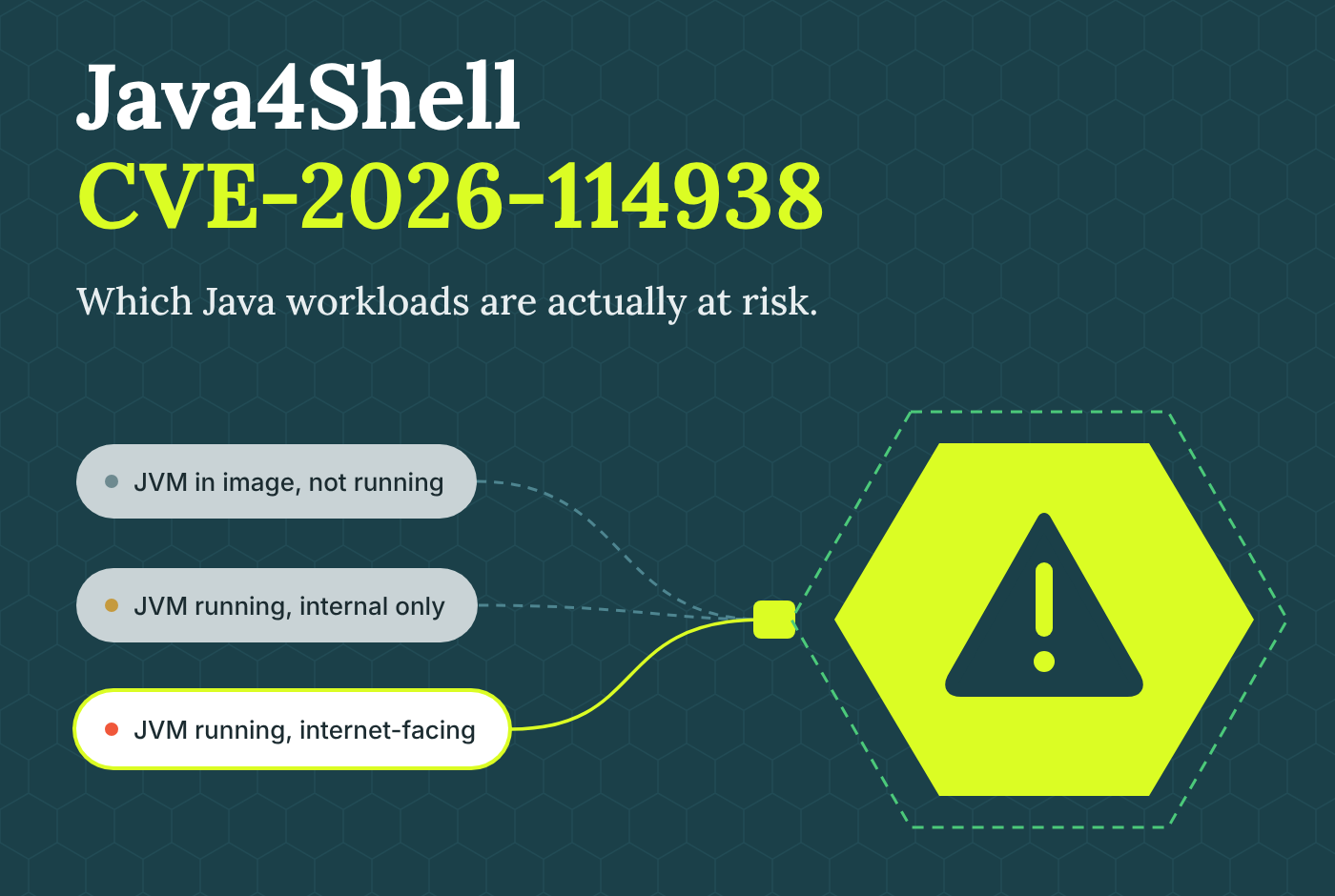
A scanner can find a vulnerable NGINX version in an image. It can't tell you whether that workload is running or whether it's reachable from the internet. NGINX also turns up in many places: as a standalone web server, as a reverse proxy in front of applications, in base container images and inside third-party products. Host-level inventories can miss some of these copies.
Start with running NGINX servers that are internet-facing, check whether HTTP/2 is enabled on each, then move to internal proxies and static sites. On affected servers, investigate unexpected NGINX worker crashes, commands launched by NGINX processes, and long-lived HTTP/2 connections that send large amounts of data. These are general warning signs, not confirmed indicators of compromise.
See Your Exposure With Sweet's Threat Intel Feed
Both CVEs are now in Sweet's Threat Intel feed. It flags every workload with an affected NGINX package and lets you filter for workloads where that package is actually loaded or executed. That turns every image that happens to contain NGINX into a short list of servers to check first.
Get Ready for AI-Speed Attacks
Researchers used AI-powered code scanning to find both NGINX flaws. This is the third critical memory-safety vulnerability in widely used infrastructure found with AI's help in about a month. PHP2Shell, disclosed Oct. 21, was also found with the help of frontier AI models. For Java4Shell, Calif says its researcher found the flaw in about an hour and built a working exploit in two more hours, for less than $200 in AI costs.
Attackers have the same tools. Five teams independently found the same NGINX flaws, and a public exploit for one of them was available on disclosure day. The gap between disclosure and attack keeps shrinking, while deploying a fixed version everywhere still takes days or weeks.
Every disclosure like this one leaves you with two questions: which workloads are running and reachable, and how do you protect them until the fixed version is deployed? Sweet's Threat Intel feed answers the first with runtime context. For the second, talk to us about Sweet Virtual Patching.
Answering both questions after every disclosure still leaves you playing catch-up. Detection alone isn't enough against AI-speed attacks, and response isn't enough either when it's the first or only thing you do. A purely reactive posture turns security into a race against the clock that you can't win. Think of a boxer who only blocks punches: sooner or later, they get worn down. To win, you have to go on offense, close the distance and set the pace. Sweet helps you do that with Attack, Fix and Defend:
- Attack: Sweet Attack puts you on offense with continuous, runtime-aware AI red teaming that proactively proves which attack paths an attacker could actually use. Because Sweet has already mapped your environment from live runtime data, you know which internet-facing workloads lead somewhere that matters as soon as the next critical flaw lands.
- Fix: Sweet shrinks your exposure while engineering works through upgrades, with runtime protection for vulnerable workloads and permission scoping that limits how far an attacker can get.
- Defend: If an attacker exploits a vulnerability before it's closed, Sweet helps you defend in real time by terminating malicious processes, quarantining containers and running response playbooks, so one compromised workload doesn't turn into a breach.
AI has changed how fast attackers move. The goal is to make attackers react to you, not the other way around. See how Sweet helps you get ahead of AI-speed attacks. Request a customized demo.