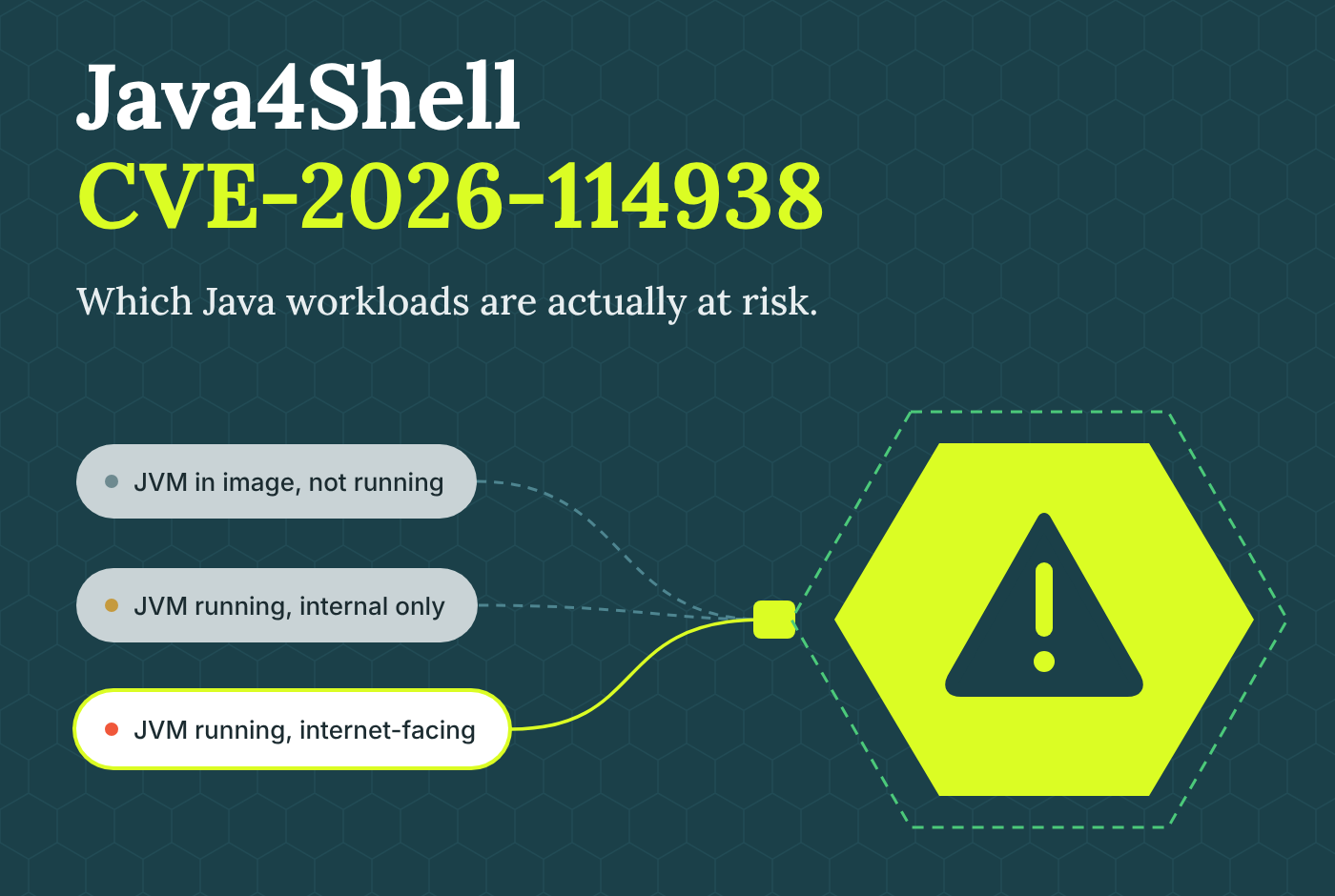
Java runs a large share of the world's business software, so a remote code execution flaw in Java itself gets attention fast. Java4Shell, also called Java2Shell and tracked as CVE-2026-114938, leaked before its fix was ready, and South Korea's National Intelligence Service warned public institutions about it before most security teams knew it existed. The researchers who found it say AI helped them do it in about an hour, and they've now published their technical details. Here's what Java4Shell is, who's affected and how to tell which of your workloads need attention first.
What Happened
Calif, a security research firm, discovered Java4Shell and reported it to Oracle. On Nov. 17, Calif said the vulnerability had leaked, and it published its technical write-up later that day, after Oracle released its patch. Calif scores the flaw 9.2 out of 10 under CVSS 4.0, which is critical.
The bug sits in the hardware-accelerated Base64 decoder built into OpenJDK's HotSpot virtual machine. Java uses that decoder to turn Base64 text, a common way to encode data in web requests, back into raw bytes. On certain processors, a specially crafted Base64 string causes the decoder to write past the end of its memory buffer. According to Calif, an attacker with no credentials can use that to overwrite memory, read memory much as attackers did with Heartbleed and reach remote code execution.
Calif demonstrated pre-authentication remote code execution against several widely used Java applications in their default configurations, including Atlassian Jira and Confluence, Jenkins, JFrog Artifactory, Keycloak and PingFederate. It also showed exploitation after login against Apache Kafka, Elasticsearch and Gerrit. Calif notes that this list isn't complete. As of Nov. 17, no exploitation in the wild has been reported.
Who Is Affected
A workload is exposed when three conditions are true:
- It runs OpenJDK 17.0.6 or later, or Java 21, 25 or 27. That covers Oracle, Amazon Corretto, Eclipse Temurin, Microsoft, Azul, Red Hat and other distributions. Standard Java 8 and 11 builds don't include the affected code, and neither do Java 17 releases before 17.0.6.
- It runs on an x86-64 processor that supports AVX-512 VBMI, such as Intel Xeon Ice Lake and later or AMD Zen 4 and later. Many AWS, Azure and Google Cloud instance families use these processors. Native ARM64 servers, such as AWS Graviton, aren't affected.
- Untrusted input reaches Java's built-in Base64 decoder. Researchers point to HTTP Basic authentication headers and some JSON Web Token libraries as common paths, because they decode attacker-supplied data before they check credentials.
How to Fix It
Oracle released patched builds on Nov. 17: 8u513, 11.0.33.1, 17.0.21.1, 21.0.13.1, 25.0.5.1 and 27.0.1.1. Other OpenJDK distributions ship fixes on their own schedules, so check your vendor's advisory for the exact fixed build. Every JVM needs a restart, and every container image that bundles Java needs a rebuild, before the fix takes effect.
Until the fixed build is running, Calif recommends starting the JVM with -XX:UseAVX=2. That option turns off AVX-512 and keeps the vulnerable code path from running, but it can also slow down other work that relies on AVX-512. Other researchers suggest -XX:-UseBASE64Intrinsics, which turns off only the accelerated Base64 decoder. Both are temporary mitigations, not fixes, so test them before you roll them out. Calif recommends upgrading even on hardware that doesn't appear to be affected, because exposure is hard to rule out.
Runtime Shows Whether You're Exposed
Java4Shell shows why a list of vulnerable packages can't tell you whether you're exposed. All three conditions above depend on what's happening in production, not on what's sitting in a repository or an image. A scanner can tell you that an image contains Java 17.0.10. It can't tell you whether that image is running, which processor the workload landed on or whether any traffic from the internet reaches it. Applications such as Jenkins and Jira also bundle their own copy of Java, which a host-level inventory can miss.
Runtime answers those questions directly. It sees the JVM loaded in memory, including bundled copies, on the host where it runs, along with the traffic it receives. That turns a long list of possibly affected images into a short list of workloads that are running, vulnerable and reachable.
See Your Exposure With Sweet's Threat Intel Feed
When Sweet finds an affected Java runtime, the threat shows "Package Detected" and lists every affected workload. Sweet then shows whether the JVM is actually loaded and running, and Sweet's Runtime Ingress indicator shows whether the workload has received real traffic from the internet. Start with running, internet-facing Java services, especially the applications Calif named and anything that decodes Base64 from incoming requests. Then confirm the processor type on those hosts. Internal workloads still need the fix, but they can follow once the services attackers can reach are covered.
Get Ready for AI-Speed Attacks
Speed matters more than it used to. Calif found Java4Shell with help from AI. In its write-up, Calif says its researcher took an hour to discover the vulnerability and two more hours to build the first working exploit, for less than $200 in AI costs. Calif calls this the era of the "centaur hacker," a skilled researcher working alongside AI, and The New York Times reports that Calif used OpenAI's GPT-6 Cyber model.
Attackers have the same kind of tools. Earlier this year, Google's Threat Intelligence Group reported with high confidence that attackers had used AI both to find a zero-day vulnerability and to build a working exploit for it. Oracle cited the same shift when it moved Java toward monthly security updates, saying "the latest generation of AI is transforming how software vulnerabilities are identified and fixed."
When a skilled researcher can go from bug to working exploit in an afternoon, the time between disclosure and the first attacks keeps shrinking, while getting a new JDK through testing, image rebuilds and restarts still takes days or weeks. Getting ready for AI-speed attacks comes down to two questions: which workloads are running and reachable, and how to protect them until the fixed version is deployed. Sweet's Threat Intel feed answers the first with runtime context. For the second, talk to us about Sweet Virtual Patching.
See how Sweet helps you get ahead of AI-speed attacks. Request a customized demo