

Security Didn’t Slow AI Down. Now What?
This week is full of prediction articles. Maybe my New Year's resolution will be to chase down last year's oracles and make them own up to their misses. Kidding, kidding!
No, instead I will dive in and make some of my own. Making predictions is very easy. Making good predictions is hard. The only way to get close is to start with a clear view of the present.
So before we look ahead, let’s be honest about where we are now.
2025: AI Inevitability
If 2024 was the year of AI adoption and 2025 was the year AI became everywhere. And no one is waiting for security's OK anymore.
In 2024, many security leaders were still cautious about AI, trying to understand the risk before they allowed it into production environments. In 2025, that hesitation mostly went away. Because CEOs stopped waiting. Competitive pressure made “secure later” the default position, which wasn't ideal, but standing still wasn’t an option.
For CISOs, this forced decisions. AI security stopped being a theoretical future problem and became a very real operational problem overnight.
2025: The Breaking Point of Siloed Security
Another defining theme of 2025 was pressure to simplify how teams approached security.
For years, security teams have been asked to piece together visibility across infrastructure, workloads, and applications using disconnected tools. By 2025, that model had reached its breaking point.
Security teams were no longer willing to act as system integrators for dozens of point solutions and alerts, especially as environments became more dynamic and attackers continued to move faster.
This led to a broader realization: siloed security models don’t work in a world where attacks don’t respect boundaries.
Another sign that siloed security models are breaking down is how badly they handle AI-driven activity.
In many environments, security signals are still looked at one layer at a time. On their own, they often look minor and stay below alert thresholds. When viewed together across infrastructure, workloads, and applications, those same signals can clearly point to a real incident.
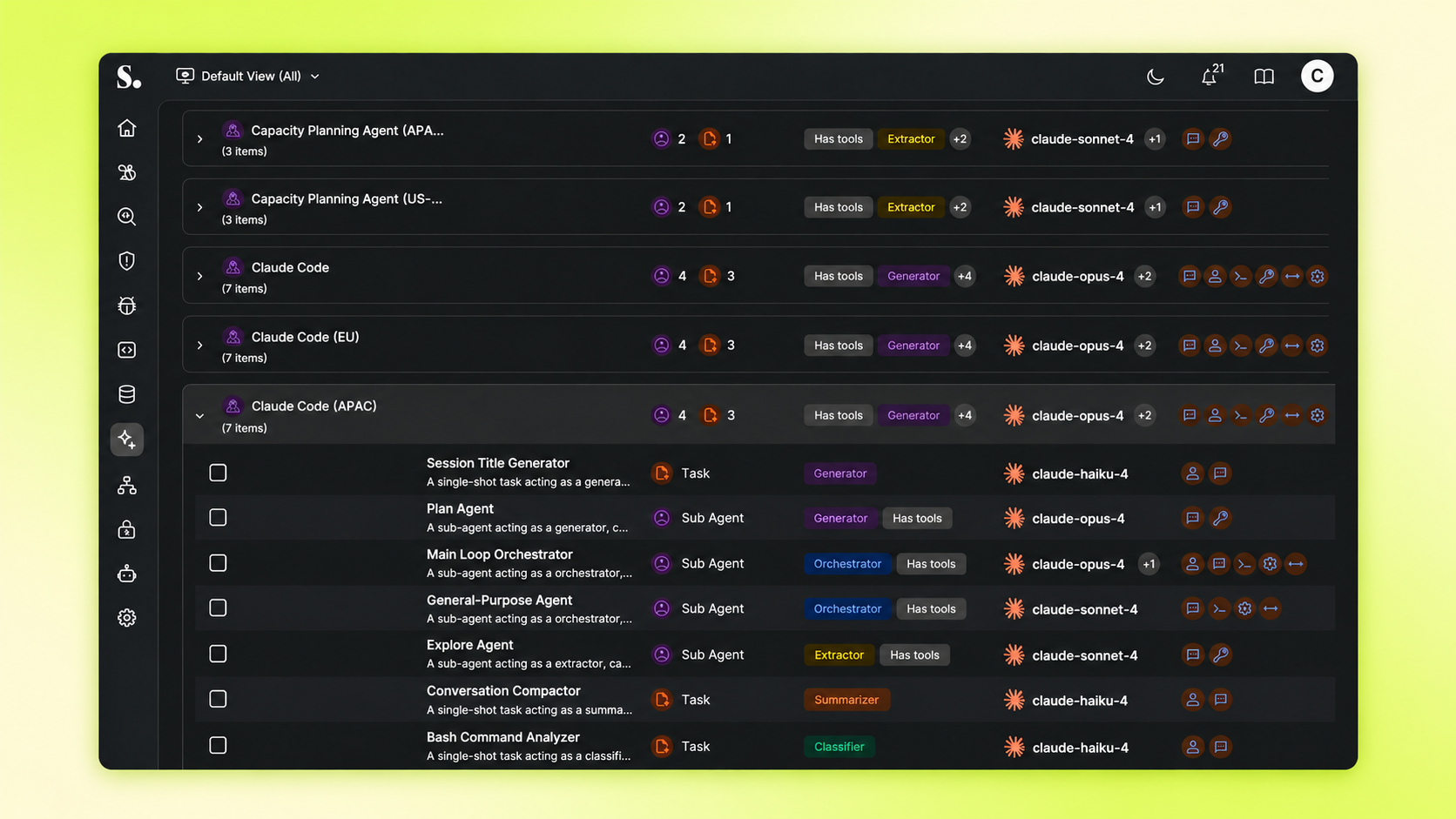
At Sweet, we’ve leaned into this reality by treating cloud and AI security as a single problem, not separate ones. The goal is a unified view that lets teams understand risk as it actually unfolds.
2025: Runtime Became the Reality Check
2025 was also the year security teams became more focused on what’s actually happening in their environments.
For several years, much of cloud security relied on static signals such as configuration states, snapshots, and periodic scans. These approaches had value, but by 2025 (really by 2024 for most) their limits were obvious. Static context alone generated too many alerts that didn't tell the whole story and couldn’t explain fast-moving attacks, ephemeral workloads, or the real behavior of cloud and AI services in production.
What changed in 2025 was to some extent technology, of course, but more importantly it was how people thought about their operations. Runtime visibility stopped being seen as invasive or risky and started being seen as a necessity. Teams became much more comfortable instrumenting their environments to understand how workloads, identities, and services behaved in real time.
By the end of the year, the question was no longer whether runtime mattered, but how to use it in the best way.
OK, I promised predictions. Here they are:
2026: AI Security and Cloud Security Fully Converge
In 2026, separating “AI security” from “cloud security” will feel artificial.
Attackers won’t treat AI workloads as isolated targets. They’ll move from cloud infrastructure to AI services and back again, exploiting identity paths, misconfigurations, runtime behavior, and data flows along the way.
Defenders will have to respond the same way.
The organizations that succeed won’t bolt on AI security as yet another tool. They’ll fold it into a unified cloud security strategy, with a single view of risk across infrastructure, workloads, applications, and AI agents.
AI security won’t replace cloud security, of course, but it will become one of its core layers.
2026: Runtime Becomes Non-Negotiable
The industry has spent years debating agentless versus runtime approaches. In 2025, that debate largely ended.
In 2026, runtime visibility stops being a differentiator and becomes the norm.
This won’t just apply to security vendors! Observability platforms, infrastructure providers, and cloud-native tooling will all find ways to incorporate runtime intelligence because customers now expect it.
So now the question won’t be whether runtime is used but only how well it’s integrated.
2026: AI Starts Shifting the Balance Toward Defenders
Much of the AI conversation has focused on how attackers might use it. That’s understandable but less than half of the story.
In 2025, we started to see credible examples of AI meaningfully helping defenders: making vulnerability discovery faster, prioritizing real risk, and reducing the backlog of issues that never seem to get addressed.
In 2026, this effect grows larger.
The number of disclosed vulnerabilities will continue to rise, that trend isn’t reversing. But the time to understand, prioritize, and remediate them will be shorter for teams that effectively apply AI.
This won’t eliminate security risk (and anyone predicting that is not worth listening to), but it will begin to close a gap that has favored attackers for far too long.
Looking Ahead
If 2025 was about the inevitability of AI, 2026 will be about integration.
The winners won’t be the teams chasing every new capability. They’ll be the ones simplifying: unifying cloud and AI security, grounding decisions in runtime reality, and using AI smartly to reduce real risk.
As I said, predictions are easy. Execution is harder.
Time to get to work.