


AI Runtime Security Best Practices
Sweet team
|
August 21, 2026
AI systems create risk the moment they start acting, not just when they are built. An agent authenticates, calls a tool, reads data, and returns an output, and every one of those live interactions can be misused. The most effective AI runtime security practices treat each interaction as something that must be authorized, constrained, and enforced in real time, not merely watched. This guide moves past passive monitoring toward active, inline enforcement.
Key takeaways about AI runtime security best practices
- AI runtime security best practices focus on inline decisions: authorize each user, agent, tool, data request, and model interaction in context, because logs cannot stop autonomous actions already underway.
- AI zero trust and least-privilege dynamic permissions reduce identity risk by checking every step, granting task-scoped access only when needed, and removing privileges before they become standing agent authority.
- Inline guardrails protect live content by validating inputs and outputs, sanitizing manipulated context, and automatically blocking unsafe responses before sensitive data leaves or risky downstream actions execute.
- Execution sandboxing, centralized AI gateways, and behavioral runtime enforcement work together to contain tool execution, apply policy consistently across traffic, and stop abnormal agent patterns at machine speed.
Run AI on a secured infrastructure.
See Sweet secure your cloud-native applications and AI agents in one platform, in a 30-minute walkthrough.

The significance of AI runtime security
Every AI risk that matters in production shows up as an interaction. A model request that pulls the wrong record, a tool call that reaches beyond its scope, an output that leaks sensitive context: none of these are visible in the code alone. They emerge when the system runs, when real users and real attackers touch it, and when an agent decides what to do next based on inputs no one reviewed in advance.
That is what makes runtime a decisive control point for AI. Build-time checks define what a system should be allowed to do; runtime is where you find out what it actually does. As agents gain the ability to call tools, chain actions, and act autonomously, the gap between intended behavior and actual behavior can widen with every deployment. These dynamics are explored further in agentic AI security fundamentals.
The rest of this guide treats that gap as the problem to solve. Each practice answers one narrowing question: what must be enforced at the moment an AI interaction happens, and why can nothing earlier in the pipeline enforce it for you?
Why AI runtime security requires active enforcement over monitoring
Most teams already have some form of AI visibility: logs of prompts, traces of tool calls, alerts when something looks unusual. That telemetry is necessary, but it describes what happened after it happened. An autonomous agent does not wait for an analyst to read the alert. By the time a suspicious tool call surfaces on a dashboard, the record may already have been read, the API already called, the data already moved.
The distinction that matters is between observing an interaction and being positioned to stop it. Monitoring sits beside the interaction; enforcement sits inside it. Everything that follows in this guide is a way of moving controls from beside the request to inside the request.
How runtime threats differ from build-time AI risks
Build-time risks are properties of the artifact: an insecure dependency, a weak system prompt, a model with known limitations. You can scan for many of them before shipping. Runtime threats are properties of the moment. They depend on who is calling, what data is in context, which tools are available, and what the agent has already done in this session.
Several risks in the OWASP Top 10 for LLM Applications only fully materialize at runtime. Prompt injection can arrive inside a document the agent reads mid-task. Excessive agency becomes an incident when a tool is actually invoked. Sensitive information disclosure happens when a specific request meets specific context. A static scan cannot see any of these, because the dangerous condition does not exist until the interaction does.
Why passive monitoring fails against autonomous AI actions
Consider a retrieval-augmented workflow that ingests a web page containing hidden instructions. A monitoring tool can log that the page was retrieved and later flag that the agent behaved oddly. It cannot prevent the injected instruction from steering the next tool call, because logging is not a decision point.
Structural limits of monitoring
- No decision point: Logs and alerts record events but never stand between the agent and the action it is about to take.
- Speed mismatch: Autonomous agents act in milliseconds; alert triage typically happens in minutes or hours.
- Context loss: By the time an event is reviewed, the session state that made it dangerous may already be gone.
Closing these gaps means placing an authorization decision in front of every interaction, which begins with treating no interaction as inherently trusted.
1. Secure every AI interaction with AI zero trust architecture
If enforcement has to live inside the interaction, the first question is what standard each interaction must pass. AI zero trust answers it the same way NIST SP 800-207 frames zero trust generally: trust is never implied by location, prior authentication, or membership in a workflow. It is evaluated per request, against current context.
For AI systems, that means a request is not trusted because it came from an internal agent, and a tool call is not trusted because the same agent made a safe one a moment ago. Every interaction (user to agent, agent to tool, agent to data, agent to model) is authorized on its own terms, at the point of action.
Verify users, agents, tools, data, and model requests continuously
Continuous verification means each participant in an AI workflow carries an identity and a scope that is checked at the point of action, not once at the session boundary. A customer-support agent authenticated for one user should still be denied when it reaches for records outside that user's account, even though the session itself is valid.
The practical shift is from authenticating the session to authorizing the interaction. The session tells you who started the conversation; the interaction tells you what is being attempted right now, and only the second question protects the data.
Enforcing strict access controls across AI workflows
Enforcing strict access controls across AI workflows means every hop in a chain is a checkpoint, not just the front door. When an agent hands off to another agent or invokes a tool that invokes an API, each transition re-evaluates whether this actor, in this context, may do this thing. Access decisions become allow/deny outcomes evaluated inline, so an unauthorized step is refused rather than only logged.
Zero trust sets the standard that every interaction must be authorized. The next question is what each authorized actor should be allowed to do, because verifying identity means little if the identity carries far more privilege than the task requires.
2. Implement least-privilege dynamic permissions to neutralize identity risks
An AI agent's identity is often one of its most dangerous assets. Agents accumulate broad permissions to be "useful": access to multiple data stores, several APIs, and a toolbox far larger than any single task needs. When that agent is manipulated, its standing privileges become the attacker's privileges. Managing this at scale is central to modern AI identity security.
Least privilege for AI cannot be static, because an agent's legitimate needs change task to task. A coding assistant that reasonably reads a repository during one request has no business writing to production infrastructure in the next. Permissions have to be scoped to the work in front of the agent, then withdrawn.
Implement least privilege access controls for AI agents and tools
Implementing least privilege access controls for AI agents and tools starts by scoping every credential to a specific task and lifetime rather than a broad role. This directly reduces the OWASP-defined risk of excessive agency: an agent cannot misuse a permission it was never granted.
Scoping agent and tool permissions
- Task-scoped tokens: Issue credentials bound to a single operation, not a standing role the agent keeps between tasks.
- Tool allowlists: Grant each agent only the specific tools its current job requires, denying the rest by default.
- Data boundaries: Constrain reads and writes to the exact records, tables, or paths the task legitimately touches.
Scoping permissions tightly is only half the problem; the other half is ensuring those permissions do not quietly expand over time.
Prevent privilege creep with just-in-time authorization
Just-in-time authorization grants elevated permission at the moment of need and revokes it when the action completes. Instead of an agent holding write access to a database indefinitely, it requests that access for a specific operation, receives a short-lived scoped grant, and loses it immediately after. Privilege creep is harder to accumulate when privilege does not persist beyond the task.
Dynamic permissions constrain what an authorized agent can reach. But an agent operating fully within its permissions can still be steered into harm by what enters and leaves it, which is where interaction content, not just interaction identity, has to be enforced.
3. Deploy inline guardrails for real-time input and output validation
Identity and permissions govern who may act and on what. They say nothing about the content of a request or a response. An agent with perfectly scoped permissions may still follow a malicious instruction hidden in a document it was authorized to read, and may still return sensitive data it was authorized to access. Guardrails address that gap by inspecting the interaction itself.
The word inline is doing the work here. A guardrail that scores content and files a report is monitoring; a guardrail that sits in the request path and can refuse to pass content forward is enforcement.
Implement guardrails for AI that validate inputs and outputs
To implement guardrails for AI, validation runs at two points: before input reaches the model or tool, and before output reaches the user or the next system. Input validation screens for injected instructions and manipulation attempts; output validation screens for leaked secrets, unsafe content, and actions the response would trigger downstream.
Two enforcement points for guardrails
- Input validation: Inspect prompts, retrieved documents, and tool results for injection and manipulation before they reach the model.
- Output validation: Check responses for sensitive data, unsafe instructions, and disallowed actions before they leave the boundary.
Placing checks at both ends only helps if those checks can act on what they find, which is the difference between sanitizing an interaction and merely flagging it.
Sanitizing and enforcing real-time interactions before execution
Sanitizing and enforcing real-time interactions before execution means the guardrail transforms or blocks content in the request path rather than after the fact. An indirect prompt injection embedded in a retrieved web page is stripped or refused before it can influence the next tool call. The enforcement happens before execution, so the malicious instruction never becomes an action. No content filter catches every manipulation, so guardrails complement rather than replace the identity and permission controls above.
Continuous runtime protection and automated blocking for unsafe responses
Continuous runtime protection and automated blocking extend the same logic to outputs. When a response would expose a secret or trigger a dangerous downstream call, the guardrail can block it automatically instead of routing an alert to a queue. Automated blocking matters because AI operates at machine speed; a human-in-the-loop review that arrives seconds later arrives after the data has already left.
Guardrails control what flows in and out of an interaction. They do not, on their own, contain what an agent can do to its host environment when a tool call executes, and that execution needs boundaries of its own.
4. Contain agent execution environments through execution sandboxing
When an agent runs code, invokes a shell, or executes a tool, it acts on a real environment with real reach. A coding assistant asked to run a build might instead be maneuvered into invoking a package manager against an untrusted source or touching files well outside its project. Execution sandboxing exists to limit what even a compromised interaction can reach beyond the box it runs in.
Sandboxing is the assumption that some interaction will eventually go wrong, made operational. It does not try to predict which tool call turns malicious; it constrains every execution so that the worst case stays contained.
Isolating agent environments to limit blast radius
Isolating agent environments means each agent, or each execution, runs in a constrained boundary with no default access to the broader system, other tenants, or the network at large. Container and namespace isolation give each execution its own limited view, so a compromised agent cannot easily pivot into infrastructure it was never meant to see. The blast radius shrinks toward the sandbox, though isolation mechanisms have known escape classes, so defense in depth still matters.
Restrict file, network, shell, and tool access during execution
Within that boundary, restriction gets specific. An execution environment should grant only the file paths, network destinations, shell capabilities, and tools the task actually needs.
Execution boundaries worth enforcing
- Filesystem: Mount only the paths the task requires, read-only wherever possible.
- Network: Deny outbound connections by default; allowlist the few destinations a task legitimately needs.
- Shell and process: Restrict or disable shell spawning and block unexpected child processes.
- Tool access: Expose only the specific tools the current execution is authorized to call.
Isolation contains a single execution, but AI systems rarely act in isolation. Agents, models, and APIs generate constant traffic that needs a common point of control.
5. Secure autonomous traffic by deploying centralized AI gateways
As AI systems multiply, so do the paths between them. Agents call models, models call tools, tools call APIs, and each connection is a place where policy could be enforced or bypassed. Enforcing controls separately at every one of those points is how gaps appear. Deploying a centralized AI gateway gives that traffic a single chokepoint where policy applies consistently.
A gateway turns scattered, per-integration controls into one enforcement plane. Every model request and tool call routes through it, which means zero trust checks, guardrails, and access decisions can be applied uniformly instead of reimplemented in each service. A centralized chokepoint also concentrates risk, so the gateway itself must be hardened and highly available. This principle underpins how API security governs autonomous traffic at scale.
Centralize policy enforcement across models, agents, and APIs
Centralizing policy enforcement means the gateway is where identity verification, permission checks, and content validation converge for all AI traffic. Rather than trusting each agent to enforce its own rules, the gateway authorizes every interaction passing through it. This is also where policy automation belongs; the mechanics of policy lifecycles are their own discipline, covered in Sweet Security's broader runtime security guide.
Inspect, route, and log AI traffic without exposing sensitive data
A gateway inspects and routes traffic while keeping sensitive data protected in transit. It can redact secrets from prompts, mask sensitive fields in responses, and record decisions for accountability without persisting the raw content it inspects. Inspection enables enforcement; it should never become a new place where sensitive context accumulates.
A gateway enforces the rules you can define in advance. But some unsafe AI behavior looks legitimate at the level of any single request. It only reveals itself across a sequence, which is what behavioral enforcement is built to catch.
6. Move beyond static scans with behavioral runtime enforcement
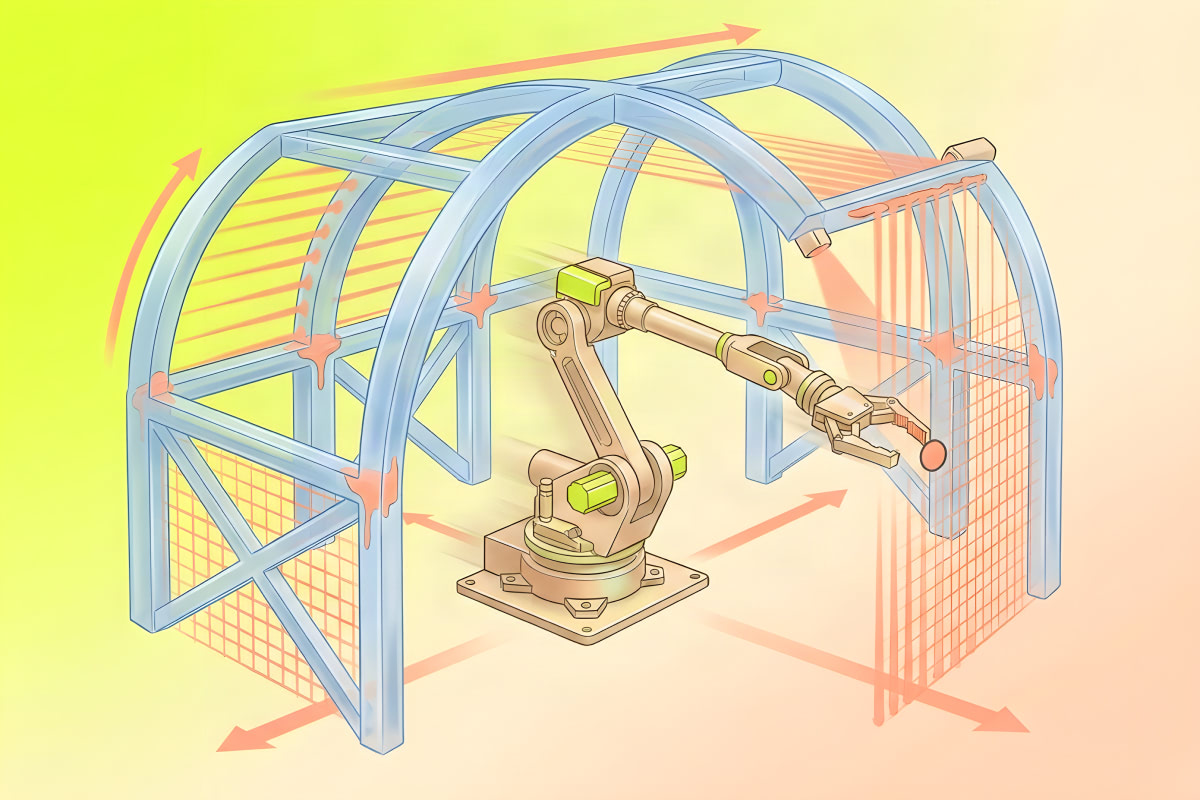
Every control so far evaluates an interaction against a known rule: this identity, this permission, this content, this boundary. But an agent can make a series of individually valid tool calls that add up to something harmful: reading a record, then another, then another, at a rate and pattern no policy explicitly forbids. Static rules miss this because the danger lives in the behavior, not the single request.
Behavioral runtime enforcement establishes a baseline of expected behavior for an agent and acts when live behavior drifts from it. It moves beyond static scans by judging interactions in the context of what came before, not just what a rule anticipated.
Detect abnormal agent behavior and tool-use patterns
Detecting abnormal agent behavior means baselining an agent's typical tools, data access, sequences, and pace, then flagging deviations. An agent that normally reads a handful of records and suddenly enumerates thousands, or one that invokes a tool it has never called in a sequence it has never followed, has drifted from its baseline even if each step is technically permitted. That drift is the signal, and baselines require enough legitimate activity to distinguish anomalies from normal variation.
Real-time AI guardrail enforcement for high-risk actions
Real-time AI guardrail enforcement turns that signal into action. When behavior crosses a risk threshold (an unusual exfiltration-shaped access pattern, a sudden privilege-seeking sequence) the system can block or pause the high-risk action rather than recording it for later review. Detection identifies the drift; enforcement stops the action it would have led to.
Each of these six practices constrains a different layer of the AI interaction. The final step is running them together, continuously, as one operating model rather than six separate projects.
Achieve full immunity with continuous AI runtime enforcement
No control set guarantees that nothing will ever go wrong. The operational goal is narrower and more achievable: every AI interaction is authorized, every permission is scoped, every input and output is validated, every execution is contained, all traffic is governed, and behavior is continuously judged, automatically, at machine speed, without waiting for a human to read an alert. The six practices become one enforcement layer that aims to block unsafe behavior before it becomes an incident while preserving the business function of the system.
Continuous AI runtime enforcement is what ties them together. Autonomous agents do not act once; they act constantly, so the controls around them cannot be point-in-time checks. They have to run as long as the agent does.
Runtime AI-SPM and agent governance for ongoing risk reduction
Runtime AI-SPM and agent governance keep the enforcement model honest over time. As agents are added, permissions shift, and tools change, governance tracks which agents exist, what they can do, and whether their live behavior still matches intent, with clear accountability for every autonomous action. This is where a Cloud and AI runtime platform earns its place: Sweet Security is one example of a platform built around continuous runtime protection and behavioral enforcement rather than monitoring alone, applying these controls across AI security, identities, and API traffic as live interactions rather than static posture.
Measure, tune, and automate AI runtime security best practices
An enforcement model has to be measured to be trusted. Track what is being blocked, tune thresholds so legitimate work is not disrupted, and automate the response so protection keeps pace with autonomous action.
Operating the model over time
- Measure: Instrument what each control blocks, allows, and flags to see where enforcement helps and where it creates friction.
- Tune: Adjust permission scopes, guardrail thresholds, and behavioral baselines to reduce false positives without loosening real protection.
- Automate: Move validated responses from human review to automatic blocking so enforcement matches the speed of the agents it governs.
AI systems create risk through live interactions, so security has to enforce what each interaction is allowed to do in context, not observe it after the fact. Zero trust, least privilege, guardrails, sandboxing, gateways, and behavioral enforcement are not six separate projects but one continuous answer to a single question: is this AI behavior allowed right now? The more autonomous production becomes, the more that question has to be answered in real time. To see how continuous runtime enforcement operationalizes these best practices, explore the complete Sweet Security runtime guide or [book a demo](https://www.sweet.security/demo
FAQs on AI runtime security best practices
How does AI runtime security differ from passive monitoring?
Passive monitoring merely logs AI interactions after they occur, leaving systems vulnerable to autonomous exploitation. Runtime security actively sits inline during execution, authorizing, constraining, and enforcing policies before actions complete.
Why are build-time security checks insufficient for AI agents?
Build-time checks evaluate static artifacts, code dependencies, and system prompts. Runtime threats like prompt injection and excessive agency only materialize dynamically during live interactions with unpredictable users, data, and context.
What is the role of AI zero trust in execution environments?
AI zero trust enforces continuous verification for every request. It never assumes an agent is safe based on past actions, forcing each user, tool, data request, and model call to prove authorization.
How do inline guardrails protect live AI interactions?
Inline guardrails validate inputs and outputs at machine speed. They inspect incoming prompts for manipulation and sanitize outgoing responses, automatically blocking secret leaks or risky actions before content leaves the system boundary.
Why is behavioral runtime enforcement necessary alongside static rules?
Static rules only catch predefined policy violations. Behavioral enforcement monitors ongoing sequences and baselines, detecting and pausing anomalous agent behavior—like sudden bulk data pulls—that appears legitimate in a single isolated request.